
· artificial intelligence · 4 min read
AI and cloud briefing: ShinyHunters demands $55m from McKesson over 284 million stolen records, the Pentagon opens ChatGPT and Grok to 3 million staff, and AWS commits to 2 million more Nvidia GPUs
The ShinyHunters extortion group claims it stole 284 million records from healthcare giant McKesson and is demanding $55.2 million. The US Department of War has added ChatGPT Mil and Grok for Government to its GenAI.mil platform for 3 million military and civilian staff. And AWS and Nvidia have expanded their GPU supply deal by another 2 million chips through 2028.
Here is our latest round-up of what’s changing in AI and cloud for UK businesses, with links to the original sources so you can read further.
Lead story: ShinyHunters demands $55.2 million from McKesson after claiming 284 million records stolen
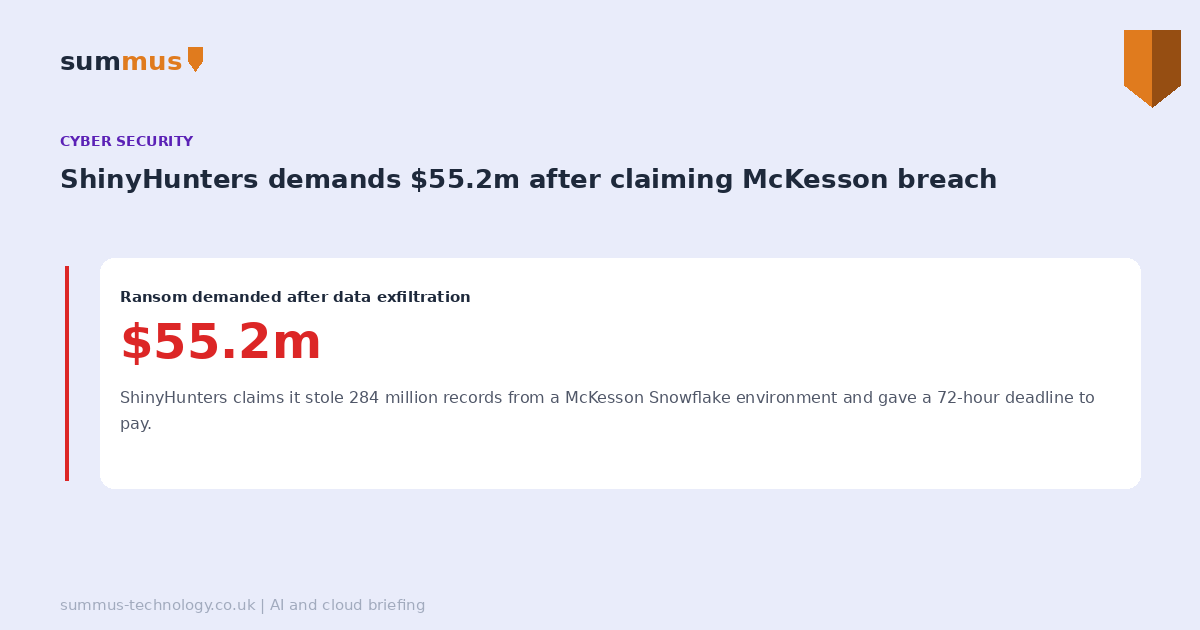
Healthcare giant McKesson has confirmed a data breach after the extortion group ShinyHunters claimed to have stolen roughly 284 million records from a McKesson Snowflake environment, following four days of data exfiltration between 21 and 25 August 2026. The group says the stolen data includes names, contact details, Social Security numbers, dates of birth, medical record numbers, Medicaid numbers, and medication, allergy and diagnosis information. ShinyHunters set a 72-hour deadline for a $55,236,150 ransom and told BleepingComputer that McKesson never responded to or attempted to negotiate the demand. The group is believed to have used voice phishing (vishing) to compromise employee credentials rather than a technical exploit. Full detail is available from BleepingComputer and TechCrunch.
Why this matters: this is one of the largest healthcare data extortion cases reported this year, and it did not start with a software vulnerability, it started with a phone call to an employee. If your business holds sensitive customer or patient data in a cloud data warehouse, it is worth reviewing who can access it, whether multi-factor authentication can be bypassed by a convincing phone call, and whether staff are trained to verify unusual credential reset or access requests before acting on them.
Frontier AI: the Pentagon opens ChatGPT and Grok to 3 million military and civilian staff
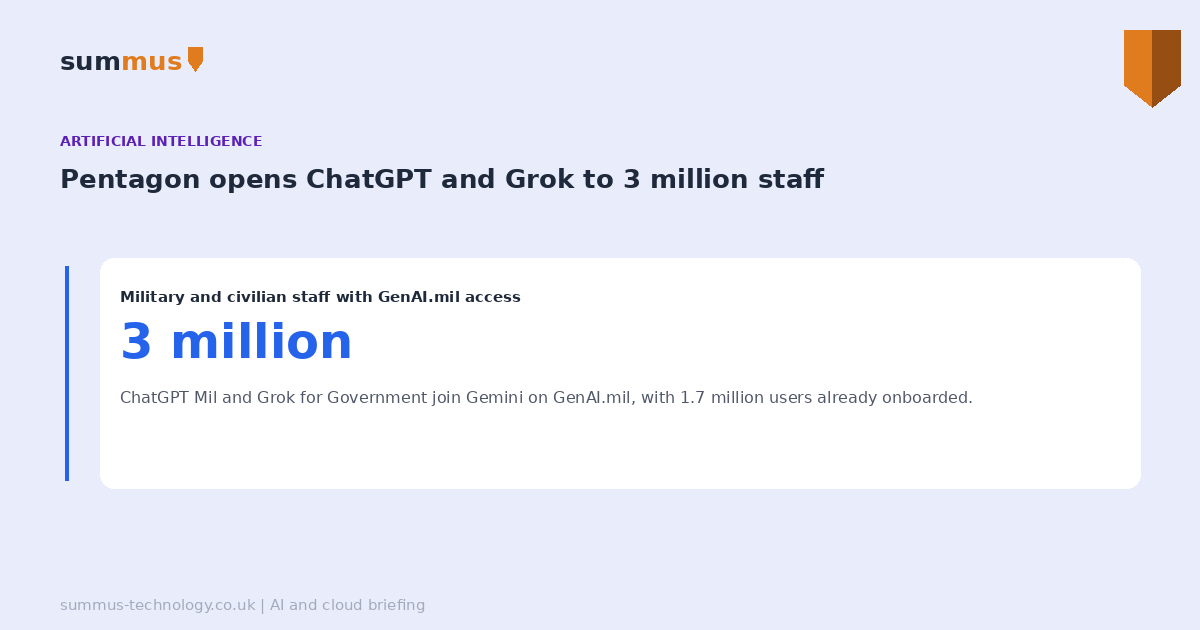
The US Department of War has added custom versions of OpenAI’s ChatGPT, called ChatGPT Mil, and xAI’s Grok, called Grok for Government, to GenAI.mil, its centralised secure AI portal that launched in December 2025 with Google’s Gemini. More than 3 million military and civilian personnel now have access, with over 1.7 million unique users already onboarded. The portal is designed to let staff use commercial frontier AI models without routing sensitive government data through ordinary consumer channels, and the department says the official versions are exempt from the data collection built into consumer products. Full detail is available from DefenseScoop and TechCrunch.
Why this matters: this shows a large, security-conscious organisation choosing to give staff sanctioned access to frontier AI tools through a controlled portal rather than trying to block consumer AI use outright, which rarely works in practice. If your business is still deciding whether to allow AI tools at work, a similar approach, a small number of approved, centrally managed tools with clear data handling rules, is often more effective than an outright ban that staff quietly work around.
Cloud & infrastructure: AWS and Nvidia expand their GPU supply deal by 2 million more chips
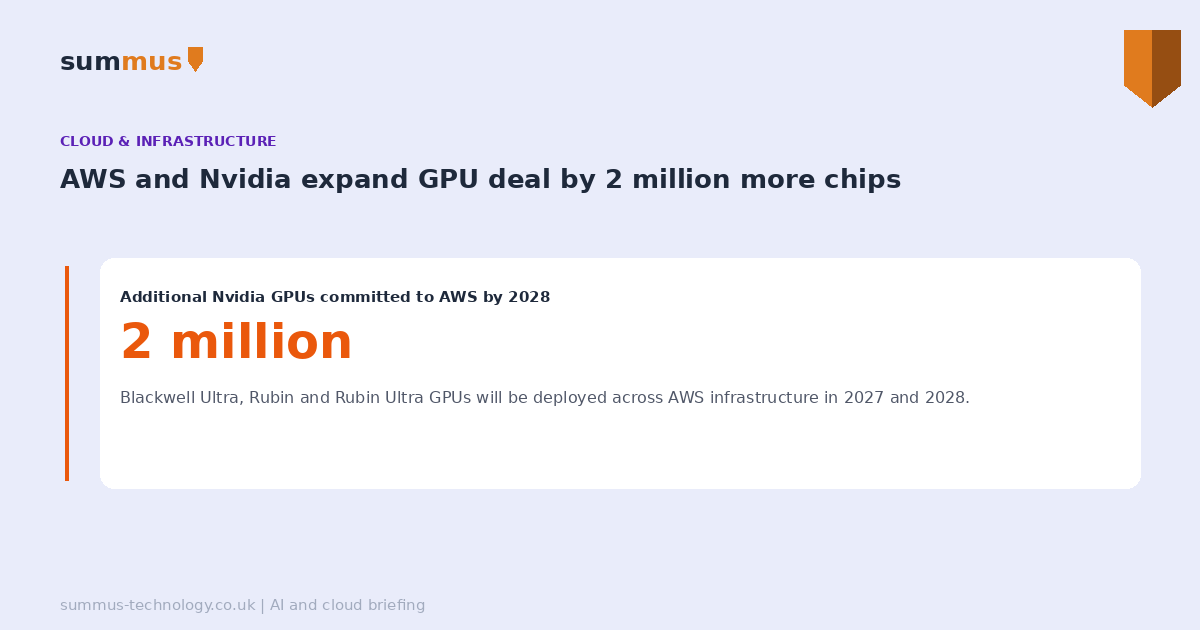
AWS and Nvidia have announced an expanded partnership to deploy an additional 2 million Nvidia GPUs, spanning the Blackwell Ultra, Rubin and Rubin Ultra architectures, across AWS infrastructure during 2027 and 2028. The expansion comes just five months after Amazon agreed to deploy more than 1 million Nvidia GPUs starting this year, and also includes Nvidia Vera CPU-based infrastructure and dedicated AI factory capacity, including 100,000 GPUs earmarked for US federal and national security workloads. Full detail is available from Nvidia Newsroom.
Why this matters: this scale of commitment, on top of an already large order placed only five months earlier, is a sign that hyperscalers still expect AI compute demand to keep outrunning supply for at least the next two years. For businesses planning cloud AI workloads, this points to continued pricing pressure and capacity constraints on the newest GPU generations, so it is worth locking in reserved capacity or committed-use pricing where your workload allows it, rather than assuming on-demand GPU access will get cheaper or easier to find soon.
The takeaway
Today’s stories cover the full range of what businesses need to think about with AI and cloud right now: a major extortion case that started with a phone call rather than a hack, a large organisation choosing controlled AI access over an outright ban, and hyperscalers continuing to bet heavily on AI compute demand. We can help you review access controls and staff training around social engineering, set up a managed approach to approved AI tools at work, and plan cloud capacity and budgets around current GPU supply constraints. Get in touch.
AI Agent based research and content, AI can do mistake, please help us to improve.