
· artificial intelligence · 7 min read
AI and cloud briefing: OpenAI arms defenders with a dedicated cyber security model, plus Meta's open 30B agent
OpenAI expands its Daybreak programme with GPT-5.6-Cyber, a model built to help vetted researchers find vulnerabilities before attackers do. Meta releases Muse Glimmer, a 30 billion parameter open model that runs on one consumer GPU. AWS open-sources Dogwood, a governance language for AI agents. And on security: Microsoft fixes more than a dozen vulnerabilities across Azure, Entra and Teams, three of them rated the maximum CVSS score of 10.0, and we flag that a Cisco Secure FMC credential fix from two weeks ago may still need applying.
Here is our latest round-up of what’s changing in AI and cloud for UK businesses, with links to the original sources so you can read further.
Lead story: OpenAI expands Daybreak with a model built for security research
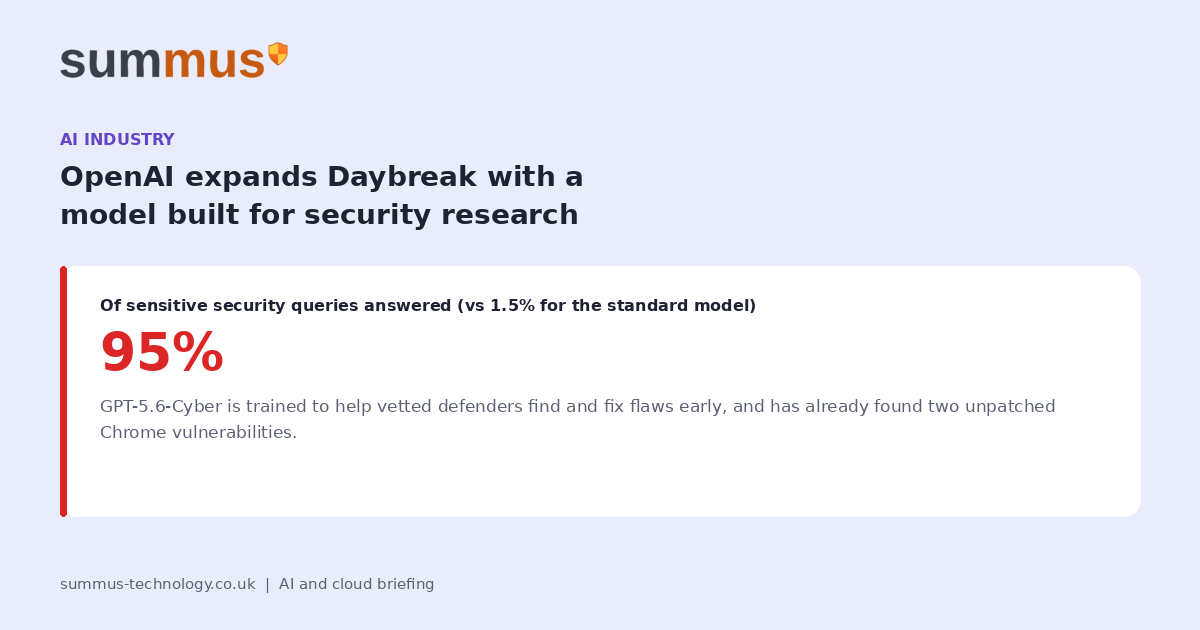
OpenAI has expanded its Daybreak cyber security programme with two access tiers and a new model, GPT-5.6-Cyber, designed to help vetted defenders find and fix vulnerabilities before attackers can exploit them at scale. Daybreak Blue covers defensive tasks such as malware analysis, while Daybreak Red gives approved security researchers access to GPT-5.6-Cyber for exploit validation and penetration testing. In an internal benchmark, GPT-5.6-Cyber answered 95% of sensitive security queries that OpenAI’s standard model blocks by default, and the company says it has already used the model to find two previously unknown Chrome vulnerabilities, which Google has since fixed. Access requires identity verification, and hardware security keys become mandatory for all Daybreak accounts from 1 September 2026. Coverage is available from The Decoder and Axios.
What is significance: giving a small pool of vetted researchers a model that rarely refuses offensive security questions is a deliberate trade-off. OpenAI’s own reasoning is that attackers will use AI for cyber attacks regardless, so giving defenders a head start is worth the added risk of controlled access. Businesses should note that dual-use AI in cyber security cuts both ways, and the identity checks around this kind of access are there for good reason.
Open source AI: Meta releases a 30 billion parameter model built to run on one GPU
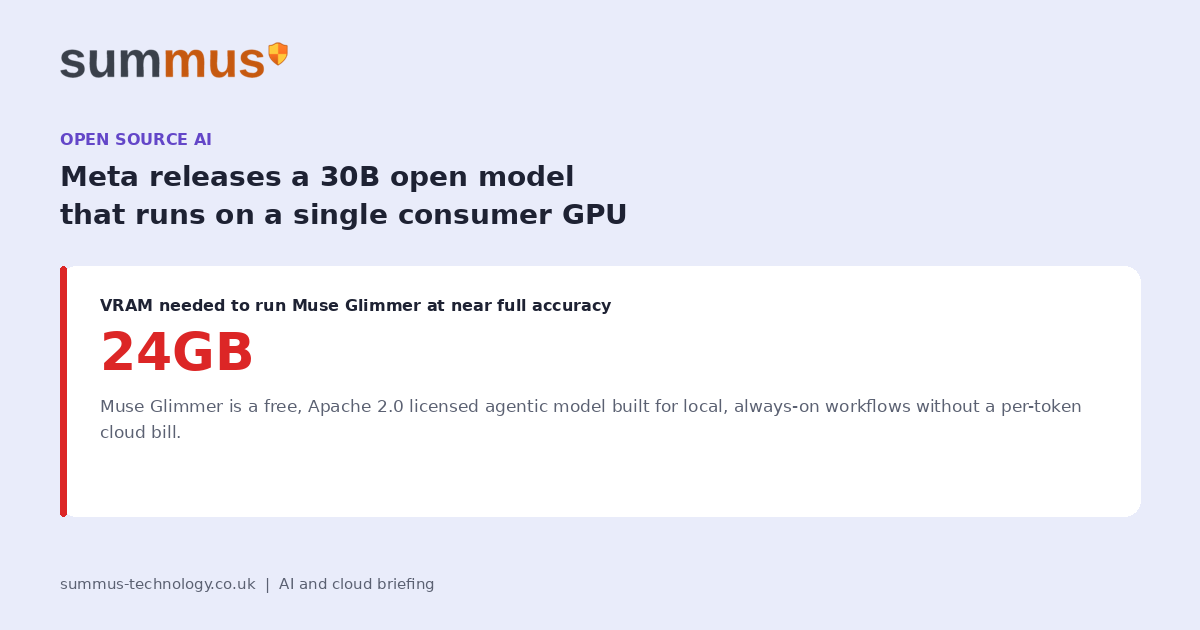
Meta has released Muse Glimmer, a 30 billion parameter multimodal agentic model distilled from its larger Muse Spark model, under the permissive Apache 2.0 licence. A model this size would normally need over 55GB of memory at full precision, but Meta compresses it to roughly 4-bit precision so it fits in 24GB of VRAM, and adds a speculative decoding technique called DFlash that gives up to a 3.1x speed-up on a consumer Nvidia RTX 5090 GPU. That means it can run on a single consumer GPU or an Apple Mac, entirely offline. Meta positions it for solo developers, mid-market teams wanting on-premises inference without a per-token bill, and regulated industries such as healthcare, legal and financial services that need data to stay in-house. Further detail is available from MarkTechPost and VentureBeat.
What is significance: open, self-hostable models that run on affordable hardware make local AI more practical for smaller organisations that cannot rely solely on the cloud, whether for cost, latency or data residency reasons. It is a useful option to know about even if most businesses will still choose managed cloud AI services for day-to-day use.
Cloud: AWS open-sources a rule-checker built for AI agents
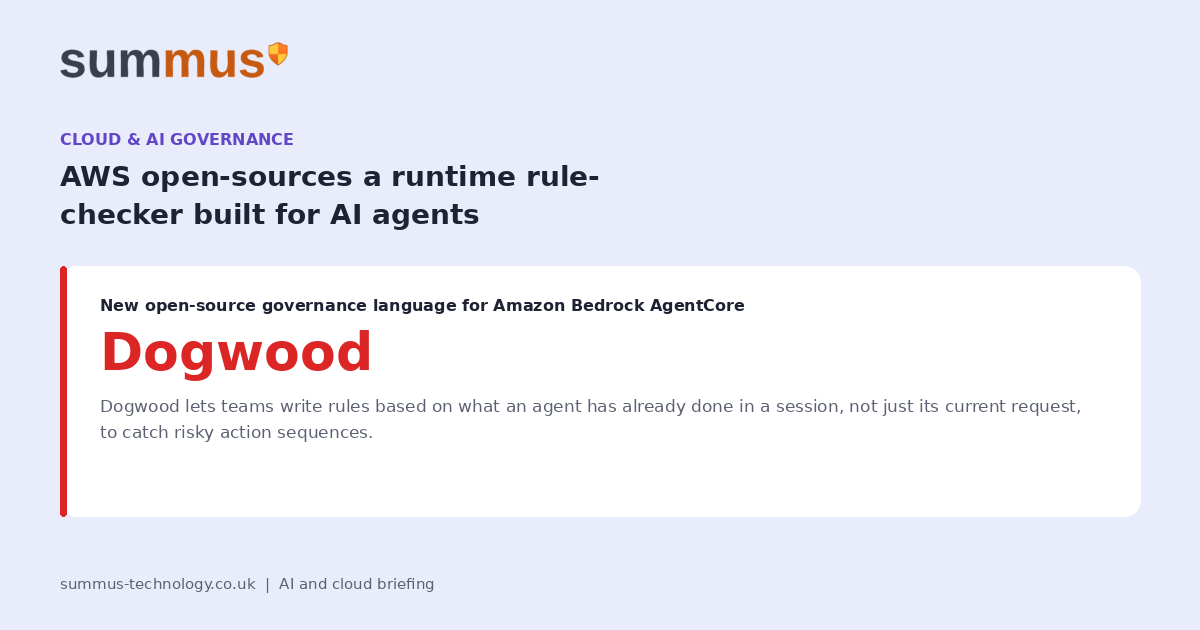
AWS has open-sourced Dogwood, a governance language purpose-built for AI agents, alongside a new capability in Amazon Bedrock AgentCore called temporal policies. The key idea is that decisions can now depend on what an agent has already done earlier in a session, not just its current request in isolation, making it possible to catch risky sequences of actions that would look fine individually. The announcement came in AWS’s regular weekly roundup alongside other agent-focused updates, including an open, vendor-neutral packaging standard called Agent Plugins for AI tool extensions. Further detail is available from the AWS News Blog and the AWS Open Source Blog.
What is significance: as businesses give AI agents more autonomy to take multi-step actions, checking a single request in isolation is not enough to catch a risky pattern of behaviour. Tooling like this is a sign that agent governance is becoming a standard part of the cloud AI stack, not an afterthought.
Security: Microsoft patches three maximum-severity flaws across Azure, Entra and Teams
Turning to security, Microsoft rolled out fixes on 6 August 2026 for more than a dozen vulnerabilities spanning Active Directory, Azure, Entra, SharePoint, Teams and other products, including several critical remote code execution and elevation-of-privilege issues. Three of the flaws, CVE-2026-63508 (missing authentication in Planetary Computer Pro), CVE-2026-56162 (improper authentication in Azure SQL Database) and CVE-2026-65667 (missing authorization in Teams), carry the maximum possible CVSS score of 10.0 and are exploitable remotely without authentication. Four further flaws, in Azure Service Bus, Azure SRE Agent, Entra Provisioning Service and Active Directory, score 9.9 and are also remotely exploitable. Microsoft has not reported any of these flaws as actively exploited at the time of publication. The release lands a week after Microsoft’s previous round of fixes for Office, 365 Apps for Enterprise, Edge and Azure Cosmos DB. Further detail is available from SecurityWeek.
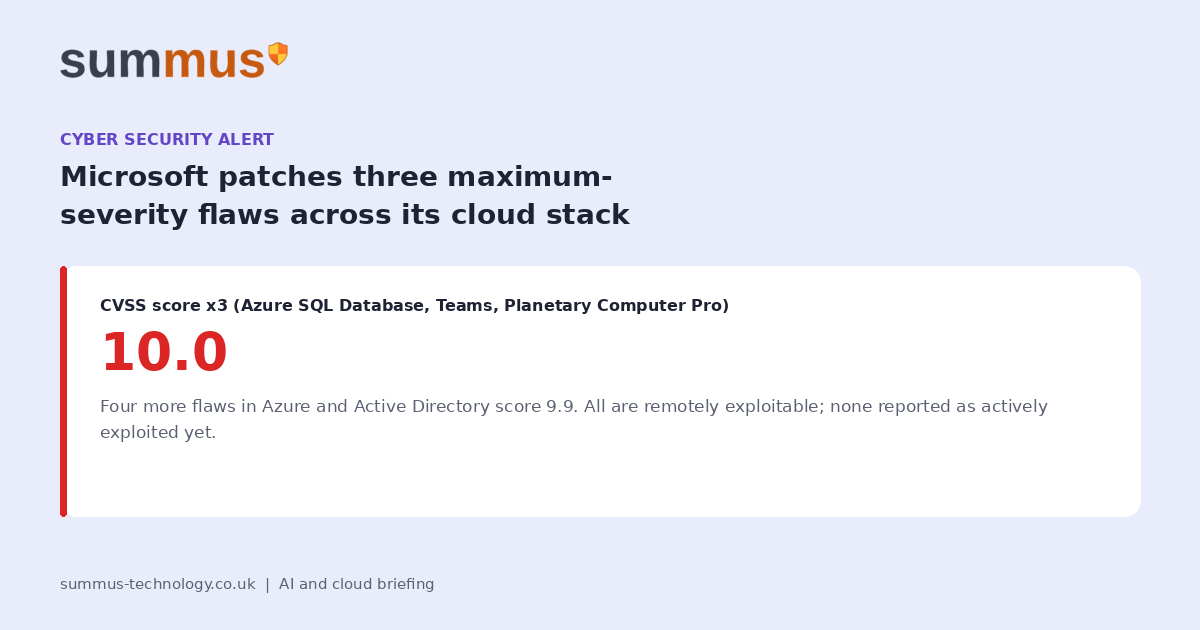
What is significance: these are elevation-of-privilege and remote code execution flaws across core Microsoft 365 and Azure services that most UK businesses rely on daily. A perfect CVSS score reflects how easily and broadly a flaw could be exploited, not that exploitation has happened, so the priority is to patch ahead of attackers rather than react to an incident.
Our advice: if your business uses Azure, Microsoft 365, Entra or on-premises Active Directory, check with your IT provider that this month’s updates have been applied, and pay particular attention to Azure SQL Database, Teams and any exposed Entra Provisioning Service integrations.
Patch reminder: Cisco’s firewall credential fix is two weeks old
A quick follow-up on a story we should have caught sooner: the static credential flaw in Cisco Secure Firewall Management Center (FMC) Software, CVE-2026-20316, is not new. Cisco published the advisory on 29 July and shipped hot fixes for every affected release branch the same day. If you or a supplier runs Cisco Secure FMC and has not yet applied the fix, treat this as a direct prompt to do so: the flaw has been actively exploited, there is no workaround, and CISA’s own deadline for federal agencies to patch passed on 1 August. Full detail remains available from Cisco’s security advisory and The Hacker News.
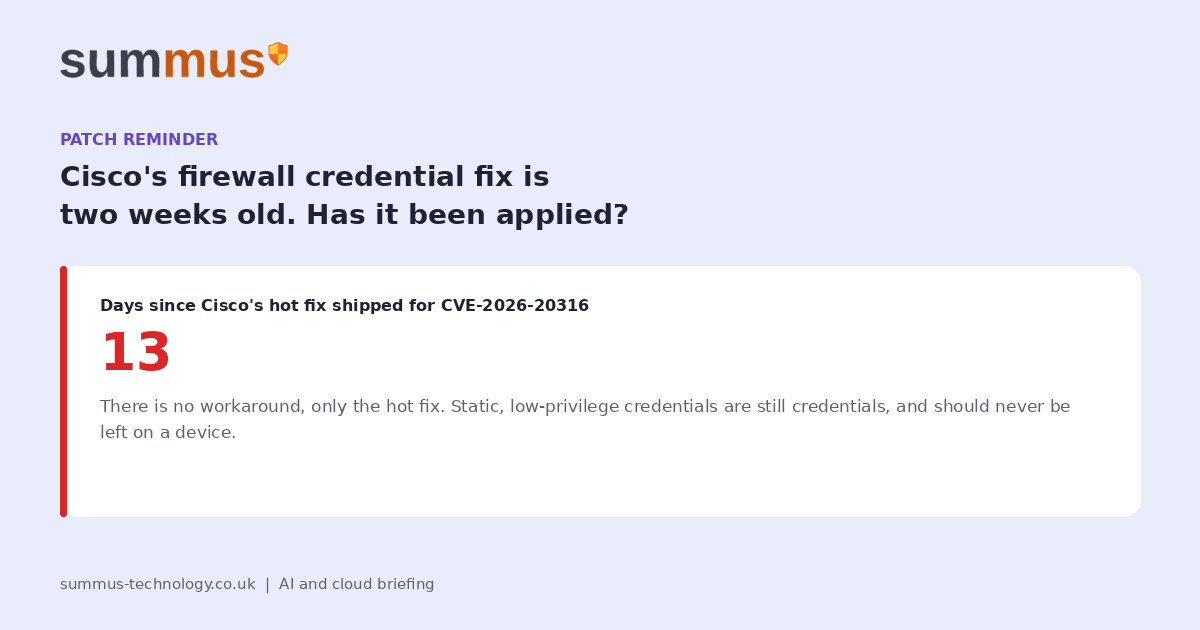
It is also worth a broader point: static, hard-coded credentials should never sit on a device, whatever the privilege level attached to them. Cisco rated this flaw “High” rather than “Critical” partly because the built-in account has limited rights, but limited access is still a foothold, and Cisco itself notes the flaw can be chained with others to reach root. When you audit your own systems, treat any built-in or default account as something to remove or rotate, not something to leave alone because it looks harmless.
The takeaway
Two significant AI releases this week, one thread underneath them: OpenAI and Meta are both shipping tools aimed at putting more capability directly in the hands of defenders and smaller teams, while AWS builds out the governance layer that more autonomous AI agents will need. Set against that, this month’s wave of maximum-severity flaws in widely used Microsoft services, and a two-week-old Cisco fix that may still be sitting unapplied, are a reminder that patching discipline cannot let up. Businesses should treat this month’s Microsoft updates as high priority, close out any outstanding Cisco FMC patching, and remember that even low-privileged built-in accounts need to be removed or rotated, not left in place because they look harmless. If you would like help reviewing your patching process or auditing built-in accounts across your estate, get in touch.
AI Agent based research and content, AI can do mistake, please help us to improve.