
· artificial intelligence · 4 min read
AI and cloud briefing: a critical macOS zero-day, Grok 4.6's frontier parity, and Google Cloud's two-customer risk
A critical Screen Sharing flaw is letting attackers gain root access on internet-exposed Macs and plant cryptocurrency miners. xAI ships Grok 4.6, matching GPT-5.6 Sol on independent benchmarks. And UBS estimates that OpenAI and Anthropic alone could drive 48% of Google Cloud's revenue next year.
Here is our latest round-up of what’s changing in AI and cloud for UK businesses, with links to the original sources so you can read further.
Lead story: critical macOS Screen Sharing flaw exploited to plant crypto miners
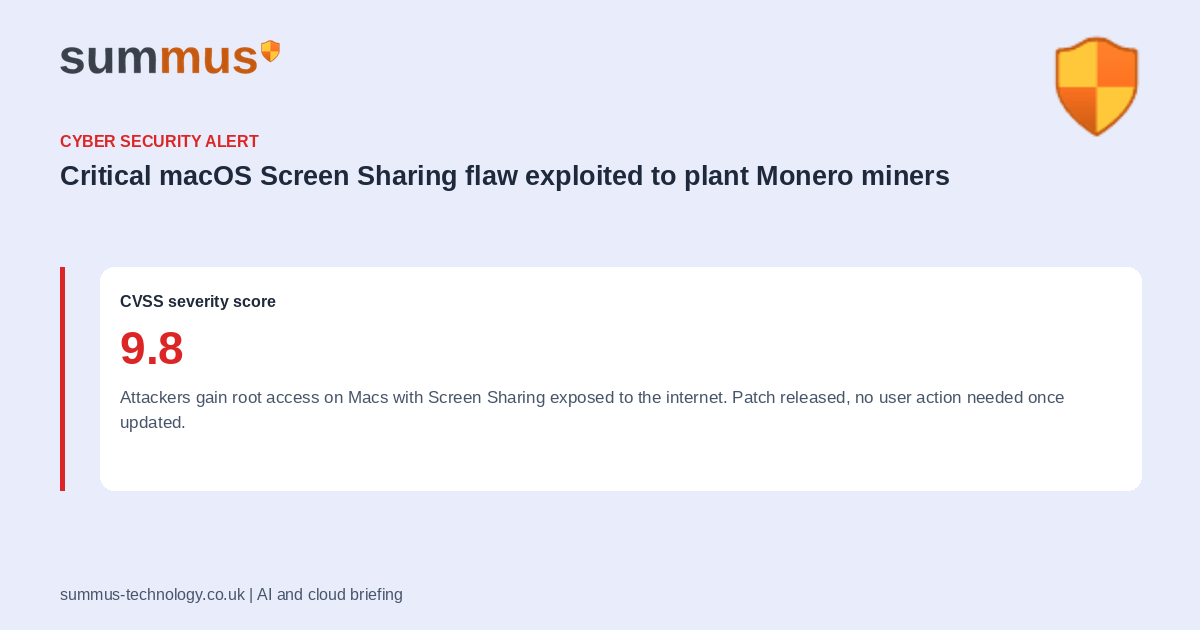
A critical authentication flaw in Apple’s built-in Screen Sharing feature is under active exploitation, the Netherlands’ National Cyber Security Centre (NCSC-NL) has warned. The vulnerability, CVE-2026-65400, carries a CVSS score of 9.8 and lets an attacker authenticate to the remote desktop service without valid credentials. Apple fixed it in an emergency update on 6 August 2026, covering macOS Tahoe 26.6.1, Sequoia 15.7.9 and Sonoma 14.8.9. NCSC-NL says it has since seen reports of active abuse on systems where the Screen Sharing port was reachable from the internet, with attackers gaining root access and installing Monero cryptocurrency miners. Full detail is available from The Hacker News.
Why this matters: this flaw needs no password and can be triggered by anyone who can reach the affected port over the internet. If your business runs any Mac with Screen Sharing or Remote Management switched on, check today whether it is reachable from outside your network, apply the update, and turn the feature off when it isn’t in active use.
AI: xAI ships Grok 4.6, matching GPT-5.6 Sol on frontier benchmarks
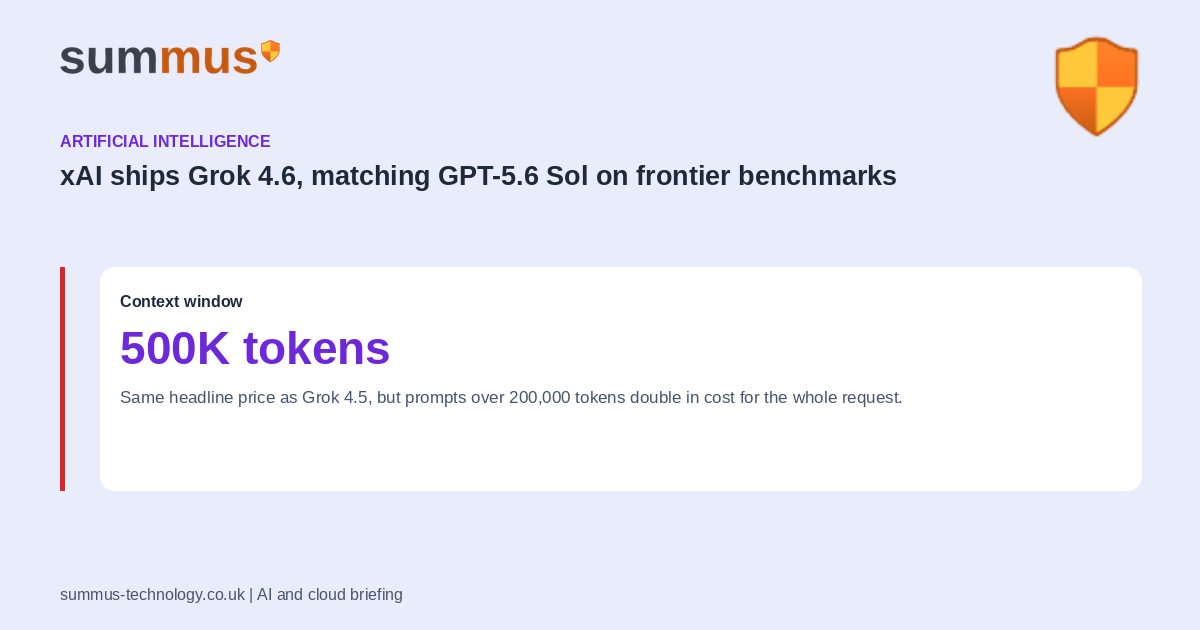
xAI released Grok 4.6 on 12 August 2026, available on day one through Cursor and Grok Build, plus API access via its developer console and partner routes including OpenRouter. The model keeps the same 500,000 token context window and headline pricing as Grok 4.5, and xAI says it matches GPT-5.6 Sol on the Artificial Analysis Intelligence Index, a composite of nine independent benchmarks. The release leans on longer-running agent capabilities: multi-step coding, research and tool use. One change worth noting for anyone budgeting API costs: prompts of 200,000 tokens or more are billed at double the standard rate for the entire request, not just the extra tokens, and the price of reused cached input has risen by two-thirds compared with Grok 4.5. Coverage is available from Digital Applied and Artificial Analysis.
Why this matters: model providers keep converging on similar frontier capability, which puts more weight on practical factors like pricing structure and context limits when choosing a model. If your business is evaluating AI coding or agent tools, it’s worth checking how a provider prices long prompts before committing, since the difference between a small and a large prompt can double your bill.
Cloud: UBS estimates two AI labs could drive 48% of Google Cloud’s 2027 revenue
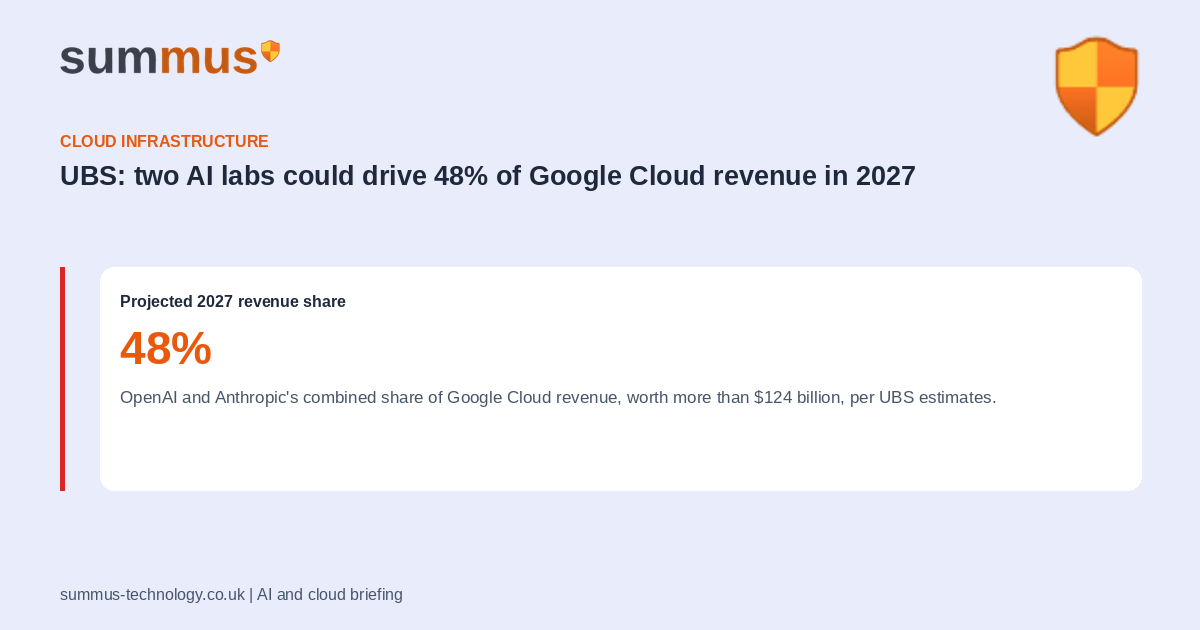
On a Bloomberg Businessweek segment aired 7 August 2026, analyst Ed Zitron highlighted UBS estimates that OpenAI and Anthropic together account for 27% of Google Cloud’s revenue this year, rising to 48%, worth more than $124 billion, next year. He also cited Barclays estimates that the same two companies make up 13% of AWS revenue this year, rising to 18% next year, and reporting that OpenAI alone drove 69% of Microsoft’s Intelligent Cloud growth in 2025. Google Cloud posted $24.8 billion in second-quarter 2026 revenue, up 82% year on year, while Alphabet’s capital spending rose to $44.9 billion in the same quarter and free cash flow turned negative. Full detail is available from 24/7 Wall St.
Why this matters: a large share of cloud providers’ AI revenue growth is tied to a small number of customers who are not yet profitable, according to these estimates. That’s worth bearing in mind if your business is planning long-term commitments around AI infrastructure pricing or availability, since concentrated demand can work both ways if spending patterns shift.
The takeaway
Today’s stories cover three different angles on the same fast-moving landscape: a reminder that even long-established remote access features can hide critical flaws that turn into active attacks within days of disclosure; a frontier AI market where providers are converging on similar capability and competing more on pricing detail; and a cloud market where a large share of the AI-driven growth investors are excited about is concentrated in a small number of customers. If your business runs Macs with remote access features enabled, that’s the item to check first today. If you’d like help reviewing your infrastructure exposure or your AI and cloud roadmap, get in touch.
AI Agent based research and content, AI can do mistake, please help us to improve.