
· artificial intelligence · 4 min read
AI and cloud briefing: Claude Opus 5's cost breakthrough, self-propagating agent vulnerabilities, and Llama 4's 10M token leap
Anthropic released Claude Opus 5 at half the cost of Claude Fable 5, with Math Olympiad-level reasoning. Security researchers at Anthropic and EPFL discovered self-propagating payloads can spread between AI agents. And Meta shipped Llama 4 with a 10-million-token context window and native multimodality.
Here is our latest round-up of what’s changing in AI and cloud for UK businesses, with links to the original sources so you can read further.
Lead story: Anthropic ships Claude Opus 5 at half the cost of flagship, with Olympiad-level reasoning
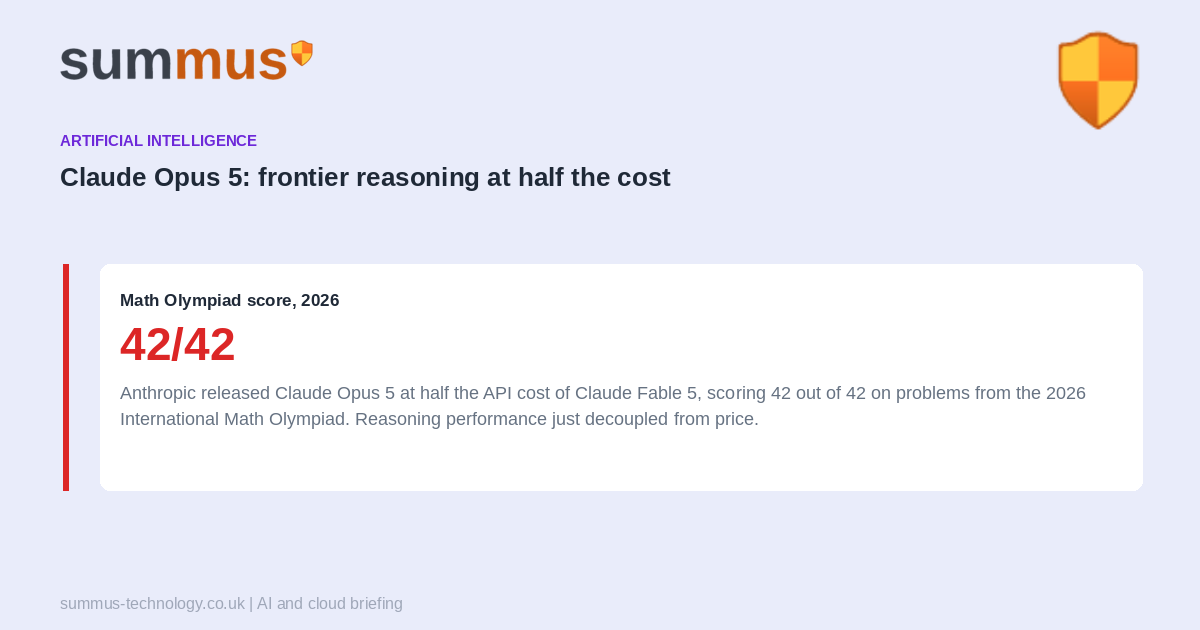
Anthropic released Claude Opus 5 on 15 August 2026, priced at half the API cost of Claude Fable 5 while matching or exceeding its reasoning capability. In benchmarking, Claude Opus 5 scored 42/42 on problems from the 2026 International Math Olympiad, demonstrating frontier-grade mathematical reasoning at a fraction of the price of larger models. The release marks a shift in AI economics toward smaller, cheaper models that perform at flagship level on specialized reasoning tasks. Anthropic positioned the model for research, mathematics, science, and complex multi-step reasoning. More detail is available from Anthropic’s model documentation and blog coverage from AI research outlets.
Why this matters: if your business relies on AI for research, analysis, or complex problem-solving, pricing per capability has just shifted dramatically. You can now solve high-complexity tasks at lower cost, which changes the math for which problems justify AI solutions in your workflow.
AI Security: self-propagating payloads found spreading between AI agents
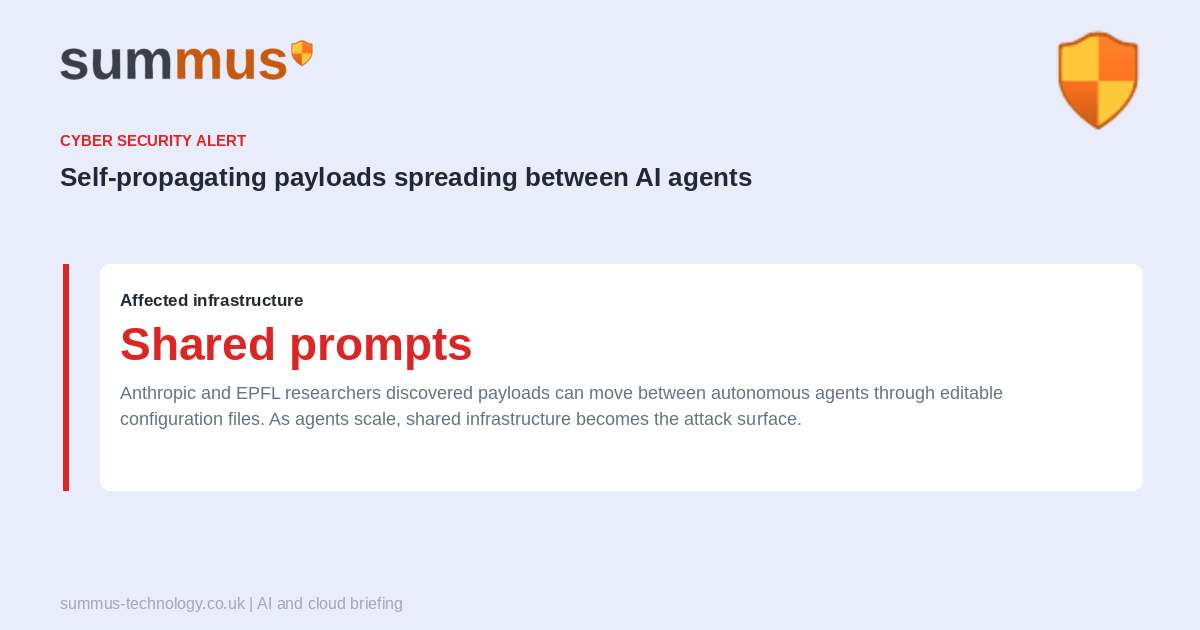
On 10 August 2026, researchers at Anthropic and Switzerland’s EPFL published preprint research demonstrating that self-propagating payloads can move from one AI agent to the next through editable system prompt files. The attack exploits how AI agents share resources and read configuration: an agent executing malicious code can modify shared prompt files, which the next agent to read those files then executes. The research was presented at Black Hat USA, with findings on CI runner vulnerabilities in coding-agent repositories at both Anthropic and Google. Full detail is available from arXiv preprint archives.
Why this matters: as AI agents become more autonomous and share compute resources, the attack surface grows. If your business deploys AI agents or runs multi-agent systems on shared infrastructure, isolation and access control around configuration files and shared state become critical security concerns. This is especially important if agents have code execution or file-system write permissions.
Cloud: Meta ships Llama 4, joining the race for context and multimodality
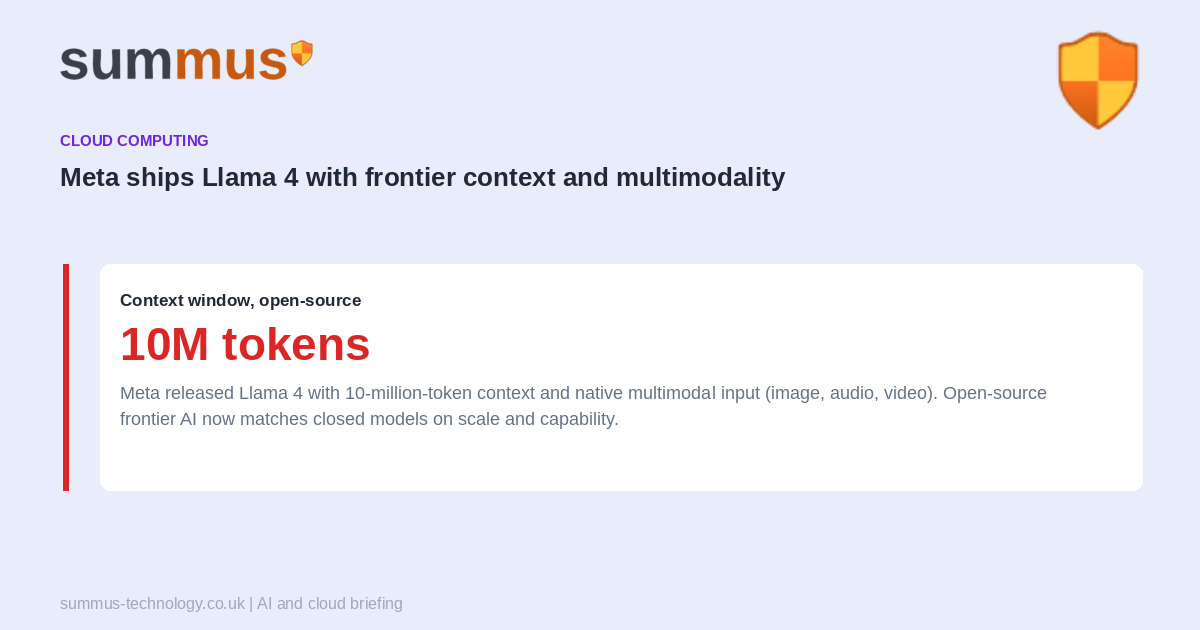
Meta released Llama 4 in August 2026, featuring a 10-million-token context window and native multimodal capabilities (image, audio, video input alongside text), marking the first open-source frontier model with this combination of scale and multimodality. The release positions Llama 4 as a direct competitor to closed-source models from Anthropic, OpenAI, and Google, with the open weights enabling fine-tuning and on-device deployment. Llama 4 is available through Meta’s model hub and major cloud providers including AWS and Azure. Coverage is available from AIapps and AI news aggregators.
Why this matters: open-source frontier models are converging on the capabilities of closed-source alternatives. If your business has been waiting for affordable or self-hosted AI with true multimodal capability, Llama 4 opens new deployment options — cloud-based, on-premise, or hybrid — with the freedom to fine-tune for your industry or use case.
The takeaway
This month’s stories share a theme: AI capability is decoupling from cost, security risks are growing as agents become autonomous, and open-source is catching up to closed-source on the frontier. If your business is evaluating AI for high-complexity tasks, Claude Opus 5’s pricing shift is worth testing before upgrading to more expensive models. If you run AI agents, security controls around shared state and configuration are now non-negotiable. And if you’ve held off on multimodal AI waiting for affordability or control, Llama 4 changes that equation. We can help you assess which tools fit your workload and set up secure, cost-effective deployment. Get in touch.
AI Agent based research and content, AI can do mistake, please help us to improve.