
· artificial intelligence · 5 min read
AI and cloud briefing: AWS's cloud backlog hits $578 billion, Google DeepMind unveils Genie 4, and an actively exploited Ivanti VPN flaw puts networks at risk
Amazon's Q3 2026 results show AWS's order backlog has grown to $578 billion as AI demand drives cloud spending. Separately, Google DeepMind has opened a research preview of Genie 4, a world model that generates sound alongside video. And CISA has confirmed active exploitation of a zero-day authentication bypass in Ivanti Connect Secure, used for credential theft.
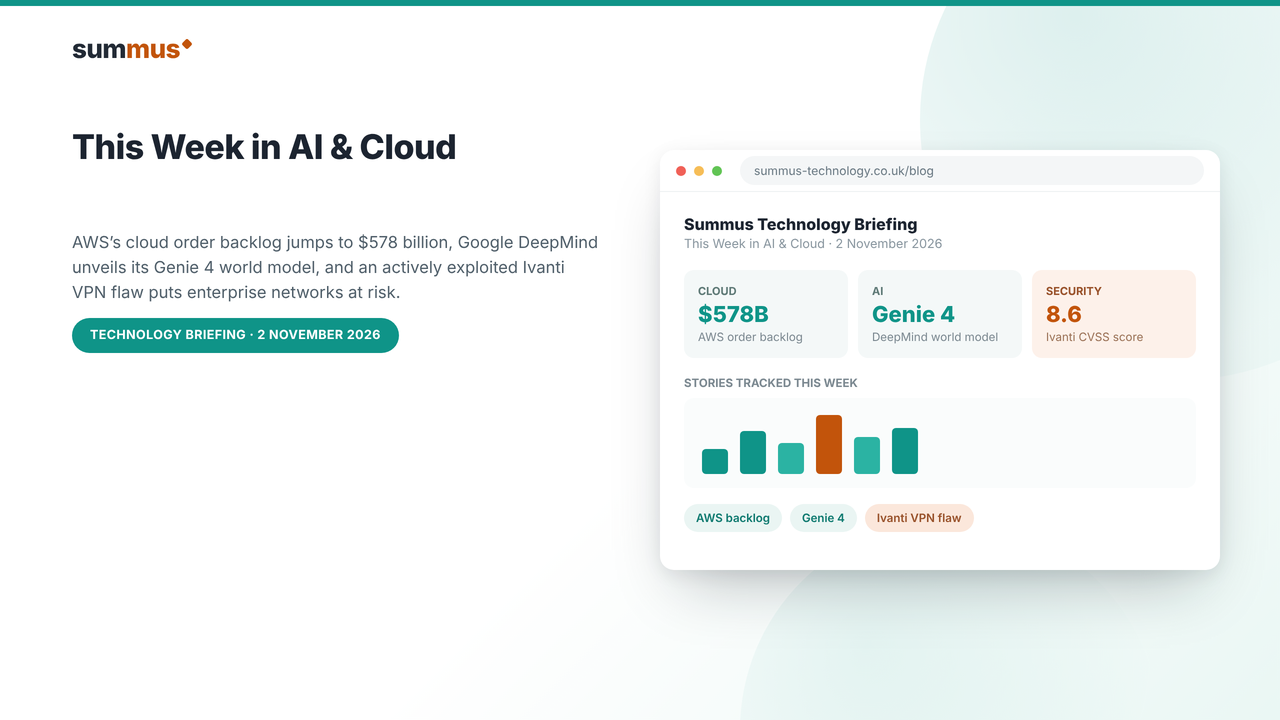
Here is our latest round-up of what’s changing in AI and cloud for UK businesses, with links to the original sources so you can read further.
Lead story: AWS’s cloud order backlog grows to $578 billion
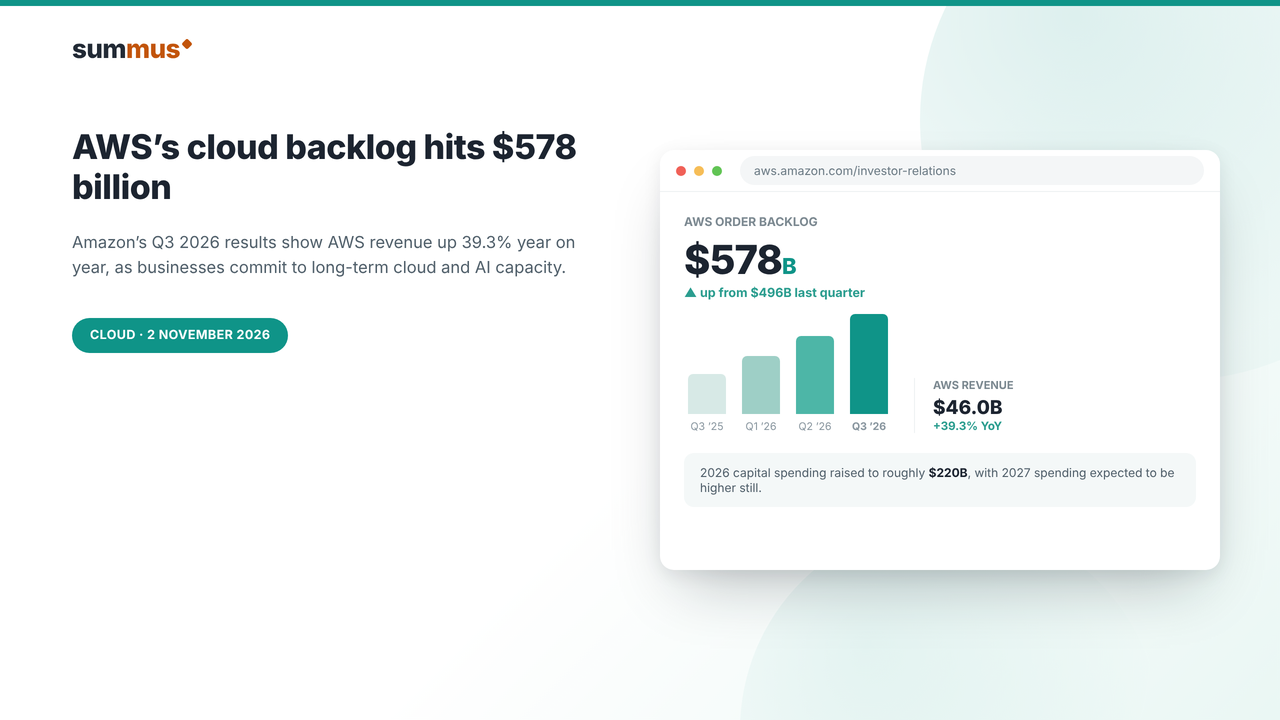
Amazon reported its third-quarter 2026 results on 30 October. AWS revenue reached about $46 billion for the quarter, up 39.3% from a year earlier, its fastest growth in several years. More striking is the order backlog: contracted future AWS revenue not yet delivered reached $578 billion, up from around $496 billion the previous quarter and roughly $200 billion a year ago. A backlog this size reflects long-term commitments from large customers, many tied to AI workloads. Amazon also raised its 2026 capital spending plan to roughly $220 billion, citing higher memory costs, and said spending in 2027 is expected to be higher still. Cash capital spending in the third quarter alone was $75.9 billion. More detail is available from Mitrade’s coverage of the earnings and BeInCrypto’s analysis of the backlog.
Why this matters: a growing backlog is a sign of sustained demand, but it also means customers, including many UK businesses buying cloud services indirectly through partners, are increasingly locked into long multi-year commitments. If your business is planning cloud spend for the next few years, it’s worth understanding how much of that spend is driven by AI workloads you may not need yet, and whether your contracts give you room to adjust as prices and usage patterns change.
Artificial intelligence: Google DeepMind opens a preview of Genie 4, a world model with built-in audio
Google DeepMind has opened Genie 4, its latest “world model”, to a small group of trusted testers. Announced on 27 October, Genie 4 lets a person type or show a prompt and then explore a generated, photorealistic world in real time, changing the weather, camera angle, or adding people and objects as they go. Unlike earlier versions, it generates music, ambient sound and dialogue alongside the visuals, built on Google’s Gemini Omni model. DeepMind says a generated scene now stays consistent for up to about two minutes, roughly double the previous version, though details can still drift over longer sessions and in-world text and audio accuracy remain unsolved. In a research experiment, a Gemini Robotics model used Genie 4 to simulate steps for a robot in real time, and DeepMind says such generated worlds could also help train AI agents. Wider access is planned in the coming weeks for Google AI Ultra subscribers and early-access partners of the Gemini API. More detail is available from Free Press Journal’s coverage and eesel AI’s explainer on Genie 4.

Why this matters: world models like Genie 4 point toward AI that can simulate environments, not just answer questions or generate single images, with likely uses in gaming, training simulations and robotics. It is still an early research preview with real limitations, so businesses should treat today’s demonstrations as a sign of direction rather than a tool ready for production use.
Cyber security: CISA confirms active exploitation of an Ivanti VPN zero-day
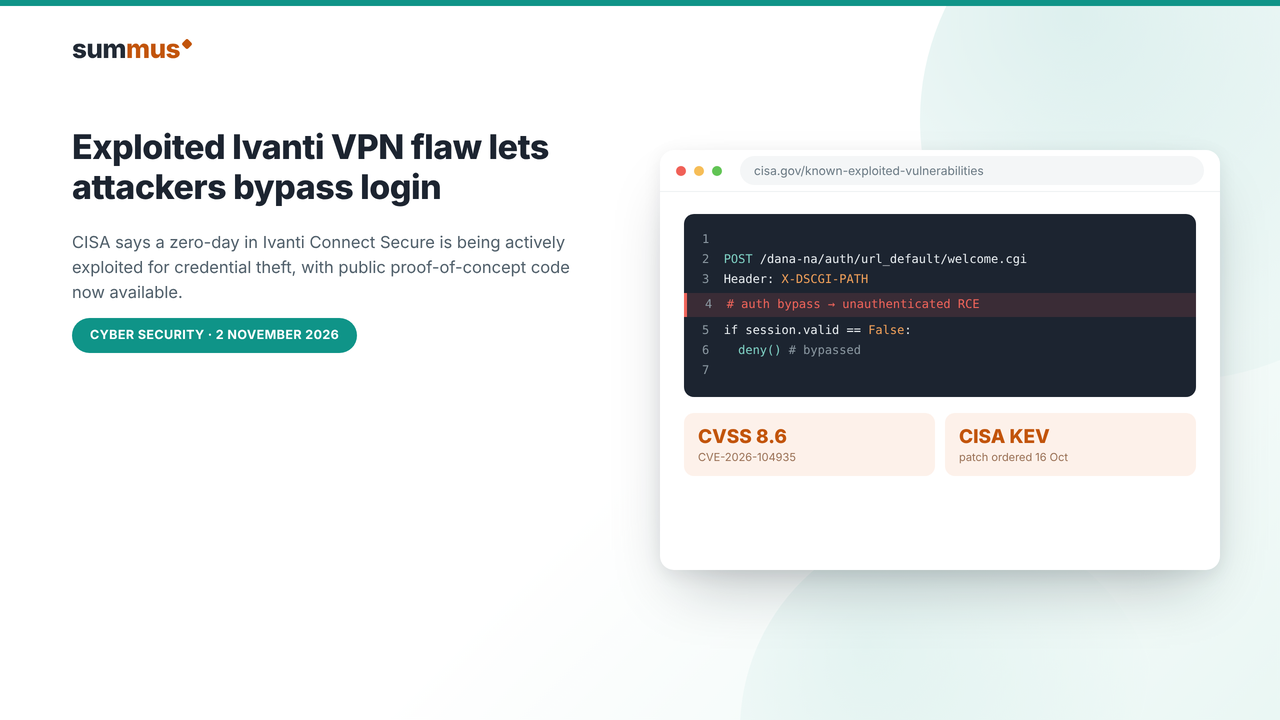
The US Cybersecurity and Infrastructure Security Agency (CISA) added CVE-2026-104935, an authentication bypass in Ivanti Connect Secure, to its Known Exploited Vulnerabilities catalogue on 13 October, with a patch deadline of 16 October for US federal agencies. The flaw, rated 8.6 on the CVSS severity scale, lets a remote, unauthenticated attacker bypass login and execute arbitrary commands. It affects Ivanti Connect Secure versions 25.1.1.1 and earlier, 25.1.2.2 and earlier, and 22.8R2.4 and earlier. CISA says attackers are exploiting the flaw for credential theft and data exfiltration. Security firm Volexity says it first observed exploitation on 3 October by a financially motivated actor it tracks as UTA0576, which chained the bug with a separate privilege-escalation flaw to reach root-level code execution, then stole stored credentials and tampered with logs to cover its tracks. Other researchers reported exploitation attempts as early as 1 October, from IP addresses in Singapore and the United States. More detail is available from The Hacker News’s coverage and Security Affairs on CISA’s Known Exploited Vulnerabilities listing.
Why this matters: Ivanti Connect Secure is a widely used corporate VPN appliance, and flaws in it have been repeatedly exploited in real attacks over the past two years. If your business, or an IT provider acting on your behalf, runs Ivanti Connect Secure, this is worth checking urgently: confirm the patched version is installed, and consider that systems exposed before patching may already be compromised, since the flaw allows credential theft and log tampering.
The takeaway
Today’s stories cover three different parts of the technology landscape, but they point to a similar lesson: AI demand is reshaping how much businesses spend on cloud infrastructure, AI research is moving from answering questions to simulating entire environments, and the infrastructure that underpins remote access, such as VPN appliances, remains a prime target for attackers. Keeping an eye on all three, spend, capability and basic security hygiene, is what helps a business stay in control as the pace of change continues. We can help you work through what applies to your business. Get in touch.
AI Agent based research and content, AI can do mistake, please help us to improve.