
· artificial intelligence · 5 min read
AI and cloud briefing: Inherent's small AI agent beats Anthropic and OpenAI at replicating research, Starcloud raises $250m for orbital data centres, and France's tax agency breach hits 678,000 people
A London AI lab's small agent outperformed frontier models from Anthropic and OpenAI at reproducing scientific papers. Starcloud raised $250 million to build data centres in orbit. And a breach at France's tax authority exposed data belonging to 678,000 people.
Here is our latest round-up of what’s changing in AI and cloud for UK businesses, with links to the original sources so you can read further.
Lead story: Inherent’s small AI agent beats Anthropic and OpenAI at replicating research
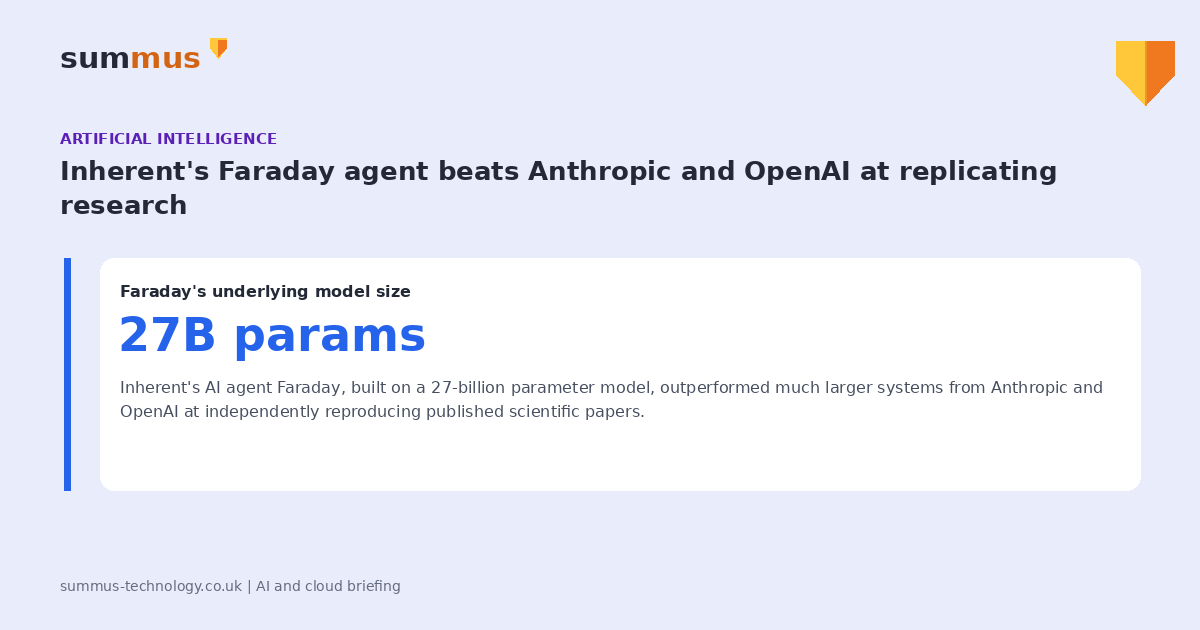
Inherent, a London AI lab founded by Google DeepMind alumni, released an AI agent called Faraday that outperformed much larger frontier models from Anthropic (Claude Opus 4.8) and OpenAI (GPT-5.5) at a specific task: independently reproducing the findings of published scientific papers without being told the answer in advance. Faraday runs on a comparatively small model called Qwen 3.6, with just 27 billion parameters, far fewer than the frontier-scale systems it beat. Inherent says beating the score wasn’t the main goal; it trained Faraday using reinforcement learning to build “research taste”, meaning judgement about which experiments are worth running, not just accuracy. The startup raised a $50 million seed round in May and plans to grow to 20 to 25 staff by the end of the year. Full detail is available from TechCrunch.
Why this matters: this is a useful reminder that bigger models are not always the right tool for a specific job. A smaller, well-trained model aimed at one task can match or beat a general-purpose frontier model at a fraction of the size and likely the cost. When choosing AI tools for your business, it is worth asking whether a smaller specialised model could do the job as well as an expensive frontier one.
Cloud & Space: Starcloud raises $250 million to build data centres in orbit
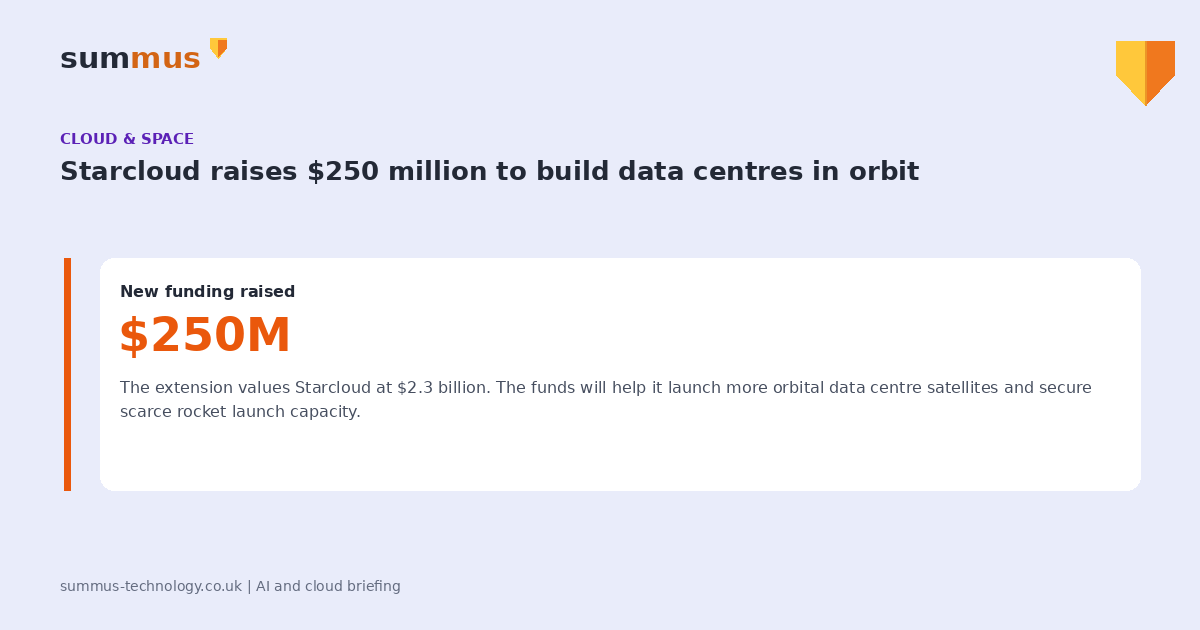
Starcloud, a startup building satellites that run AI inference in space, added a $250 million extension to its earlier $170 million funding round, valuing the company at $2.3 billion. The round was led by Manhattan West Ventures, with Nvidia and Cisco also taking part. The money will fund a larger manufacturing facility and Starcloud’s next orbital data centre spacecraft, which is intended to fly on SpaceX’s Starship rocket. Starcloud has asked US regulators for permission to operate 88,000 spacecraft and says booking enough rocket launch capacity is now one of its biggest challenges, since SpaceX plans to retire its workhorse Falcon 9 rocket by 2028 while the larger Starship remains unproven. Starcloud already runs an Nvidia H100 chip in orbit and is helping Nvidia design a space-hardened GPU for future missions. Full detail is available from TechCrunch.
Why this matters: this is still an early and expensive bet, but it shows serious investors, including a major chipmaker, backing the idea that some AI compute could eventually run in space rather than on the ground. It is a sign of how constrained and competitive access to AI computing capacity has become on Earth.
Cyber Security: France’s tax authority confirms breach affecting 678,000 people
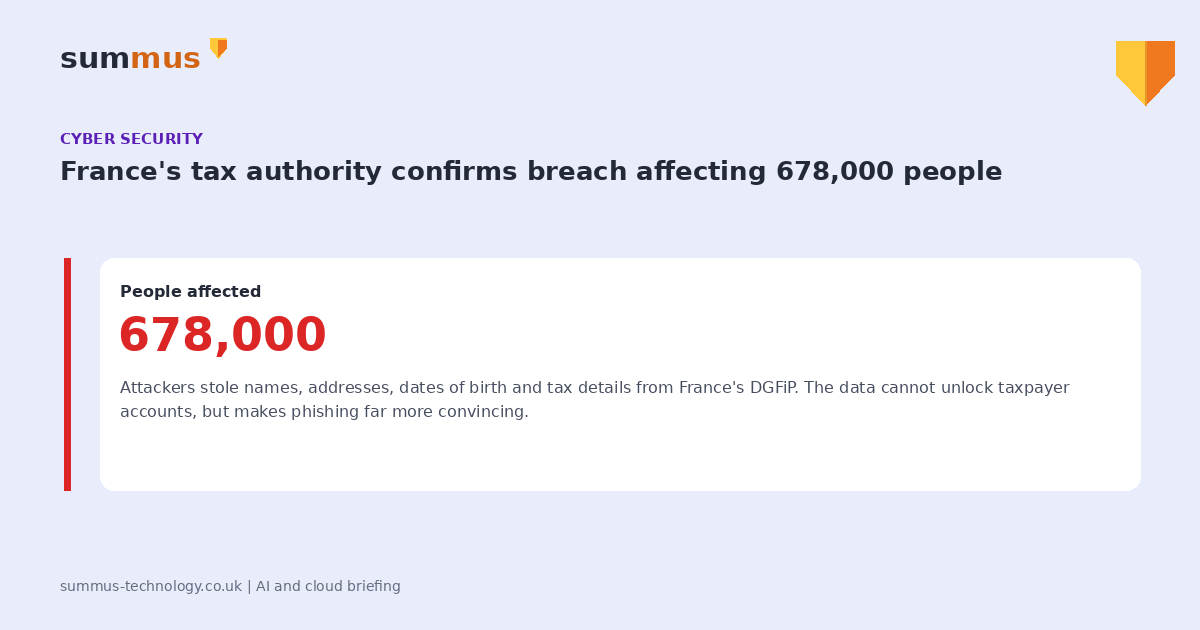
France’s General Directorate of Public Finances, known as the DGFiP, confirmed that attackers accessed its systems in July and stole records belonging to 678,000 individuals, along with a smaller amount of business data. A hacker using the handle “ZeroBytes” listed the stolen database for sale on a hacking forum on 12 August. For individuals, the stolen data includes names, dates of birth, home addresses, phone numbers, family circumstances, taxable income and tax withholding rates. The DGFiP says this data cannot be used to log into the taxpayer portal directly, but warns it could make phishing attempts far more convincing. France’s Public Accounts Minister ordered the agency to begin notifying affected people from 17 August. Full detail is available from Help Net Security and BleepingComputer.
Why this matters: stolen personal and financial details rarely unlock an account directly, but they make follow-up phishing emails and calls much more convincing because they contain real, accurate information. If your business handles customer financial data, this is a good moment to remind staff and customers to be cautious of unexpected messages that reference personal details, even if those details are correct.
The takeaway
Today’s stories point to a common theme: businesses are being asked to think harder about fit rather than just scale. A smaller, well-trained model beat larger rivals at a specific task, showing that the biggest AI model is not always the best choice. A well-funded startup is looking beyond Earth for computing capacity because ground-based capacity is tight. And a major government breach shows that even when stolen data cannot unlock an account, it can still be used to make an attack far more convincing. We can help you choose the right-sized AI tools for your needs, plan for future compute and cloud capacity, and review how prepared your team is for realistic phishing attempts. Get in touch.
AI Agent based research and content, AI can do mistake, please help us to improve.