
· artificial intelligence · 4 min read
AI and cloud briefing: two big bets on making AI actually work, and a record patch day
A short, factual briefing for 24 July 2026: Microsoft and Amazon spend billions embedding engineers into customer teams, SAP bets over a billion euros on AI for spreadsheets rather than chatbots, and Oracle ships its largest ever security update while a separate SonicWall flaw is under active attack.
Here is our latest round-up of what matters in AI and cloud for UK businesses. It is short and factual, with links to credible sources so you can read further.
Microsoft and Amazon bet billions on making enterprise AI actually work
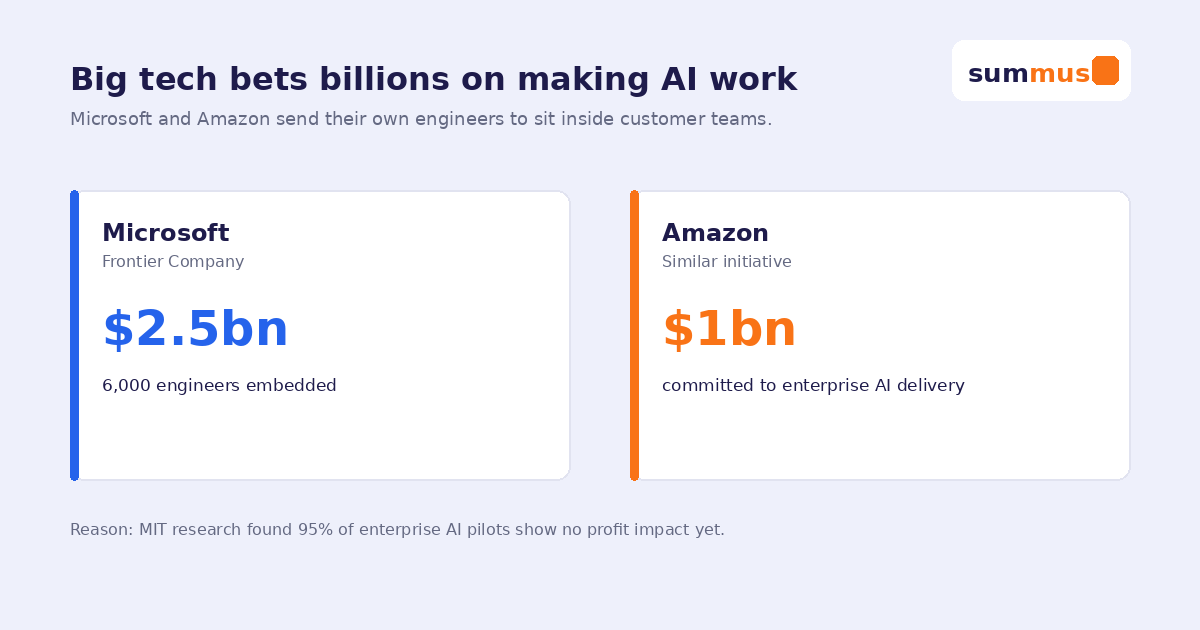
Microsoft has launched Frontier Company, a $2.5 billion push that embeds around 6,000 of its own engineers and specialists directly inside customer teams to build and run AI systems on-site, with contracts tied to measurable business results rather than software sold. It follows a similar $1 billion commitment from Amazon. Both moves respond to research from MIT’s Project NANDA, which found that 95% of enterprise generative AI pilots show no measurable impact on profit yet.
Why this matters: the gap between buying AI tools and getting real value from them has become the industry’s biggest problem. The largest vendors now think the fix is people on the ground, not just better software.
What to do this week:
- If your own AI pilots have stalled, you are not alone. Ask what specifically is blocking value: data quality, process change, or skills.
- Treat any vendor offer of “embedded” delivery as a signal of how hard this genuinely is, not just a sales pitch.
- Set a measurable business outcome before starting any new AI project, not after.
SAP bets over a billion euros on AI for spreadsheets, not chatbots
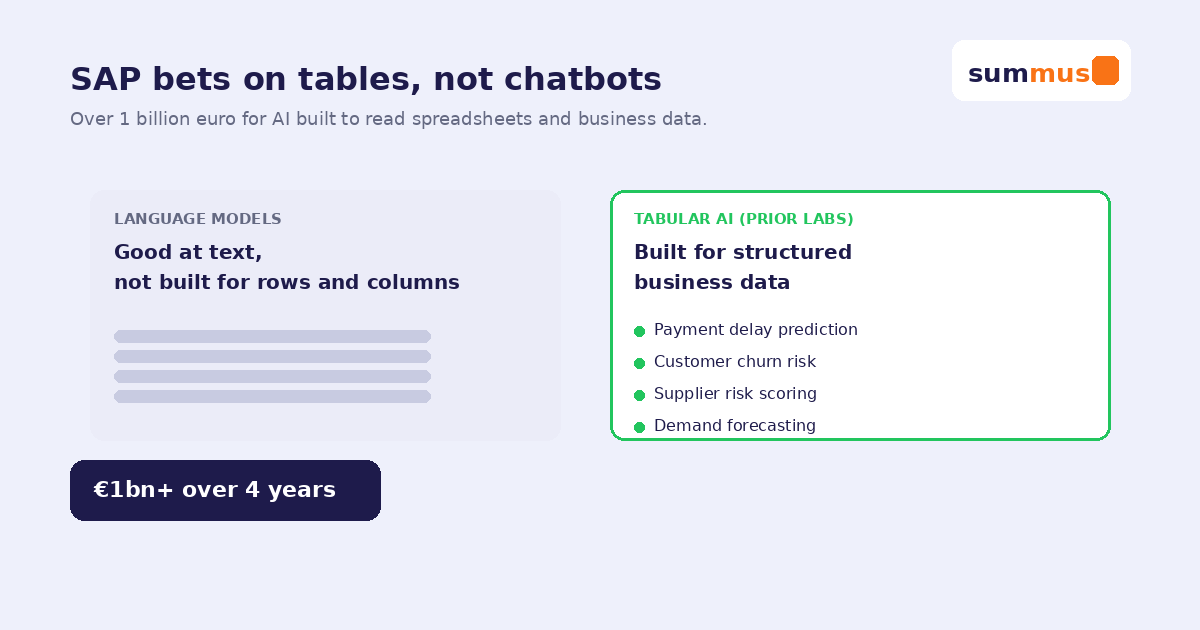
SAP has completed its acquisition of Prior Labs, a German AI lab founded only 18 months ago, and will invest more than €1 billion over four years to build it into a European frontier AI lab. Prior Labs pioneered tabular foundation models: AI trained specifically to work with structured business data such as spreadsheets and databases, rather than free text. According to Tech.eu, the technology is built for tasks like predicting late payments, customer churn, supplier risk and demand, directly from the tables companies already hold.
Why this matters: most business decisions run on rows and columns, not paragraphs. SAP’s bet is that a model built specifically for that kind of data will outperform a general language model asked to do the same job.
What to do this week:
- If you are only exploring chatbot-style AI, note that a separate category built for structured data is maturing quickly and may fit forecasting or risk tasks better.
- Ask any AI vendor whether their model was built for text, for tables, or for both, and what evidence backs their claim on your kind of data.
- Keep an eye on this space if you use SAP; expect tabular AI features to reach mainstream SAP products over the next few years.
The biggest patch day on record, and a perfect-10 flaw in the wild
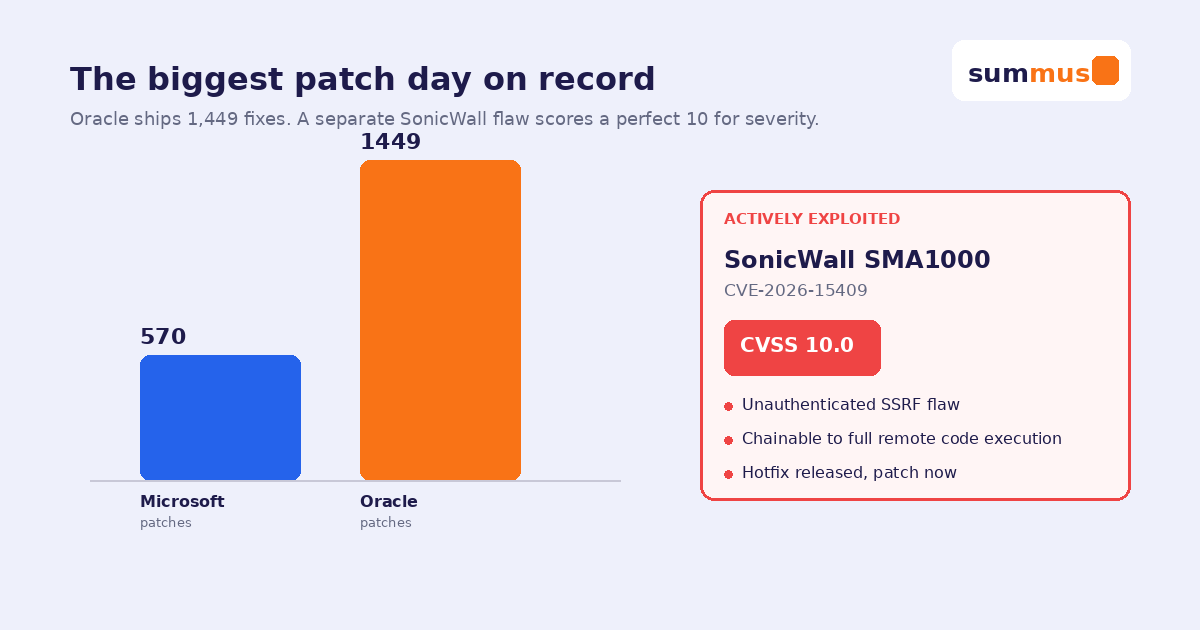
Oracle released its July 2026 Critical Patch Update, shipping 1,449 security patches, the largest in the company’s history, covering databases, middleware, cloud services and enterprise applications. The same week, Microsoft’s July Patch Tuesday addressed roughly 570 vulnerabilities of its own.
Separately, and more urgently, SonicWall confirmed that two flaws in its SMA1000 remote access appliances are being actively exploited. CVE-2026-15409 is an unauthenticated server-side request forgery flaw rated the maximum CVSS score of 10.0. Tenable reports it can be chained with a second flaw, CVE-2026-15410, to gain full remote code execution on the appliance. Rapid7 says its researchers observed targeted exploitation before the flaws were even disclosed.
Why this matters: a record-sized patch load makes it easy for one urgent fix to get lost in the queue. The SonicWall flaw affects internet-facing appliances used to grant remote access to company networks, which makes it a priority above the rest.
What to do this week:
- If you run a SonicWall SMA1000 appliance, apply the hotfix now, not on your normal patch schedule.
- Do not let a large patch batch become an excuse to delay. Triage by exposure: internet-facing systems first.
- Ask your IT provider or MSP to confirm, in writing, that both fixes are applied.
The takeaway
Three stories, one common thread: getting real value from AI is proving harder than buying it, whether that is embedding people to make pilots work, picking a model actually built for the data you have, or patching flaws before attackers use them. If you would like help reviewing your AI strategy or your patch priorities, get in touch.
AI Agent based research and content, AI can do mistake, please help us to improve.