
· artificial intelligence · 4 min read
AI and cloud briefing: hidden AI reasoning can leak passwords, Google hands its A2A protocol to open governance, and Z.ai ships a 743-billion-parameter open model
Researchers showed that encrypted AI reasoning blocks can leak API keys and passwords across sessions. Google moved its A2A agent protocol under the same open governance as Anthropic's MCP. And Z.ai released GLM-5.3, a 743-billion-parameter open-weight coding model.
Here is our latest round-up of what’s changing in AI and cloud for UK businesses, with links to the original sources so you can read further.
Lead story: hidden AI reasoning can leak API keys and passwords
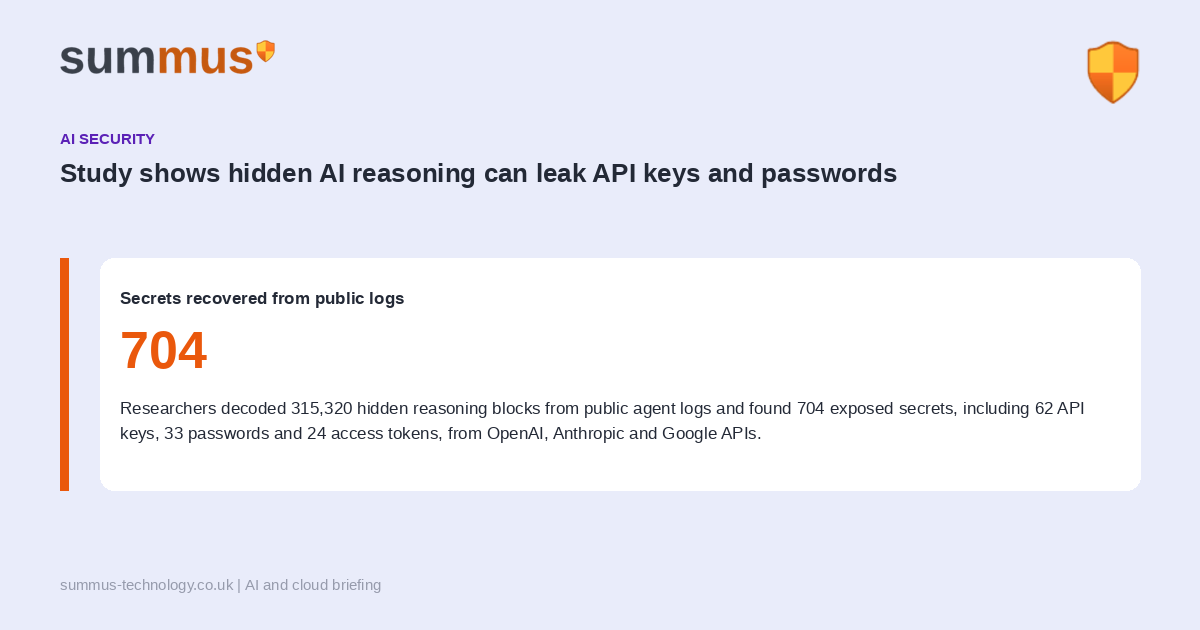
Security researchers found a way to recover hidden reasoning content, including real API keys and passwords, from the encrypted “thinking” blocks used by OpenAI, Anthropic and Google’s reasoning APIs. These providers let applications carry hidden reasoning between API calls as an encrypted object, rather than exposing the raw thinking text. The researchers showed these blocks could be replayed across different sessions, different users, and even handed to a smaller, weaker model from the same provider to get it to transcribe the hidden content. Scanning 6,708 public agent logs, they decoded 315,320 hidden reasoning blocks and recovered 704 exposed secrets from genuine user sessions, including 62 API keys, 33 passwords, 24 access tokens and seven private keys. The providers were notified, and the researchers say the main extraction attack no longer works as of August 2026, though none of the three companies has publicly confirmed the fix. Full detail is available from The Hacker News.
Why this matters: this only affects developers who published raw agent logs with the hidden reasoning objects left intact, not every user of these AI platforms. But it’s a useful reminder that “encrypted” does not always mean “safe to publish.” If your team shares agent transcripts for debugging or demos, strip out any hidden reasoning fields first, the same way you would redact a password from a screenshot.
Cloud & Standards: Google hands its A2A agent protocol to open governance
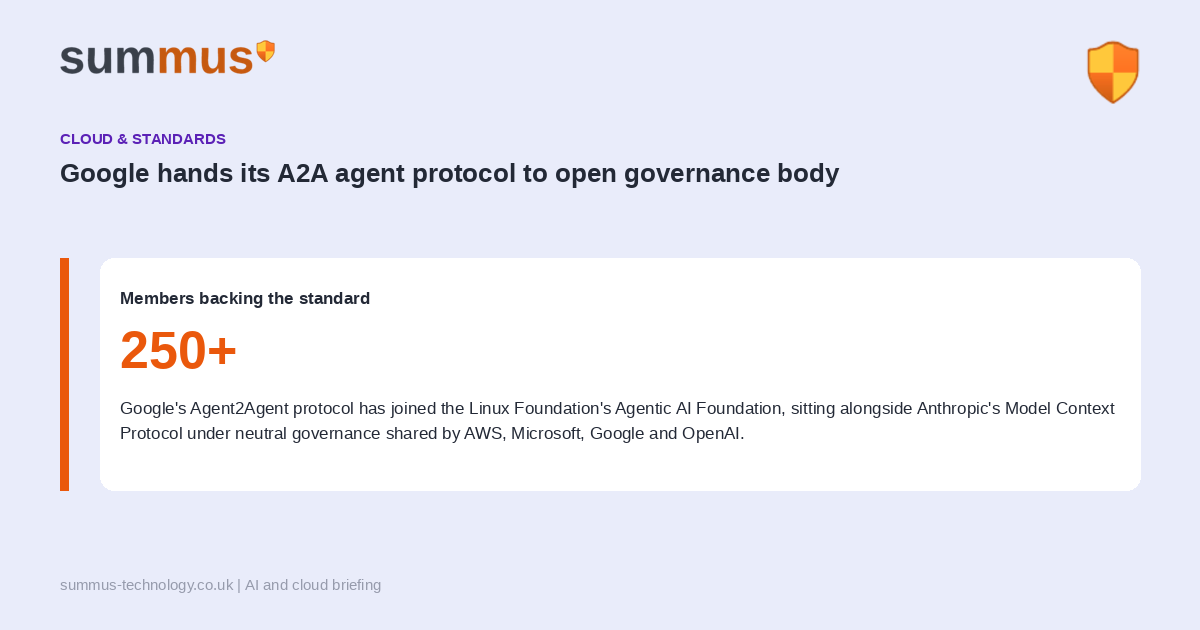
Google’s Agent2Agent (A2A) protocol, which lets AI agents built on different platforms discover and communicate with each other, has moved from Google’s own stewardship into the Linux Foundation’s Agentic AI Foundation (AAIF). This places it under the same neutral governance as Anthropic’s Model Context Protocol (MCP), which handles how agents connect to internal tools and data. The AAIF now has more than 250 member organisations, including AWS, Anthropic, Google, Microsoft and OpenAI. The two protocols are designed to be complementary rather than competing: MCP connects an agent to its tools, and A2A connects agents to each other. Full detail is available from Forbes.
Why this matters: when the biggest cloud and AI vendors agree to run a standard through neutral, shared governance rather than keeping it under one company’s control, it reduces the risk of getting locked into a single vendor’s way of connecting AI agents. If you are planning multi-agent AI projects, both MCP and A2A are worth understanding, since together they are becoming the common plumbing for how AI agents talk to tools and to each other.
Artificial Intelligence: Z.ai releases GLM-5.3, a 743-billion-parameter open-weight coding model
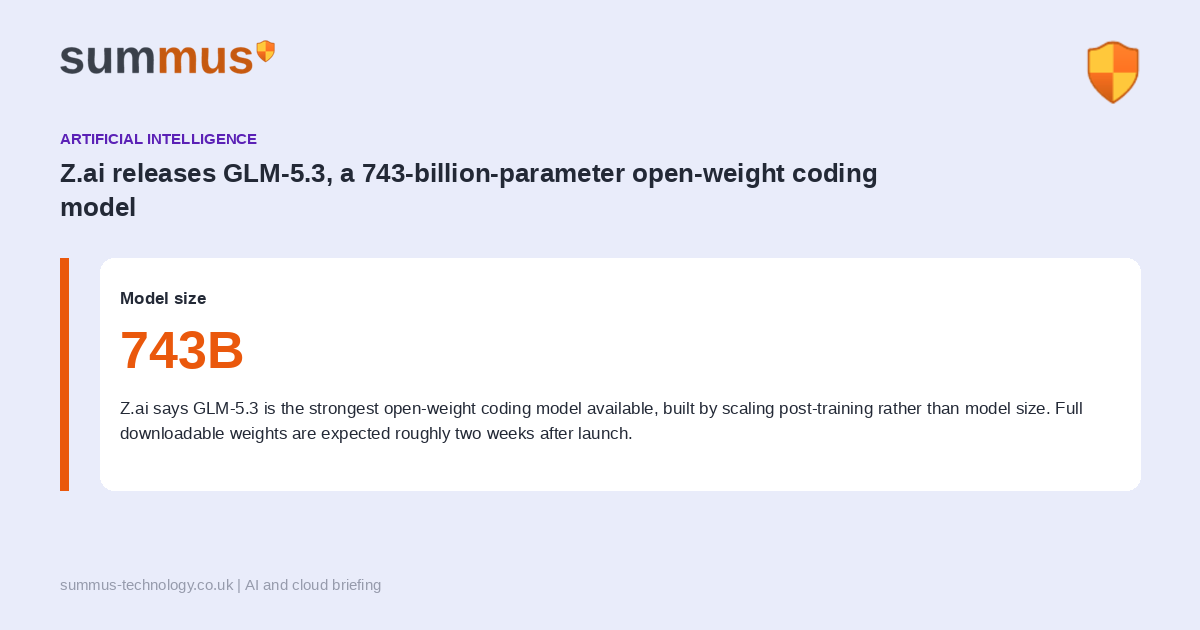
Chinese AI lab Z.ai released GLM-5.3, which it is calling the strongest open-weight coding model currently available. The model has 743 billion parameters and is already accessible through Z.ai’s coding subscription plan, with the full downloadable weights due roughly two weeks after launch once safety review is complete. Z.ai says the gains came from scaling up post-training, meaning more varied training tasks and more compute spent on them, rather than simply making the model bigger. On the company’s own coding benchmark, GLM-5.3 scored 34.5%, up from 23.4% for its predecessor, while also using noticeably fewer tokens per task. Full detail is available from Decrypt.
Why this matters: open-weight models that businesses can download, inspect and run on their own infrastructure keep getting closer to the closed, proprietary frontier. That gives UK businesses more choice over where sensitive code and data are processed, though it is still worth checking the licence terms and running your own evaluation before relying on any new model for production work.
The takeaway
Today’s stories share a theme of trust and control in AI systems. A security flaw in “hidden” reasoning shows that convenience features can create new places for secrets to leak if logs are shared carelessly. A major protocol moving to open governance shows the industry choosing shared standards over vendor lock-in for agent-to-agent communication. And a large open-weight model gives businesses more choice over where their AI workloads actually run. We can help you review how your team handles AI agent logs and API keys, plan for multi-agent architectures using open standards, and evaluate whether an open-weight model fits your workload and compliance needs. Get in touch.
AI Agent based research and content, AI can do mistake, please help us to improve.