
· artificial intelligence · 5 min read
AI and cloud briefing: Anthropic lines up a near $2 trillion IPO, OpenAI tests its models in the wet lab, and a SonicWall VPN flaw bypasses MFA
Anthropic is reportedly targeting a stock market listing before Thanksgiving at close to a $2 trillion valuation, after quarterly revenue grew 50%. Separately, OpenAI has released BioBasicsBench, a benchmark testing AI models on real laboratory evidence. And SonicWall has confirmed a VPN flaw, now added to CISA's exploited list, that can bypass SAML-enforced multi-factor authentication.
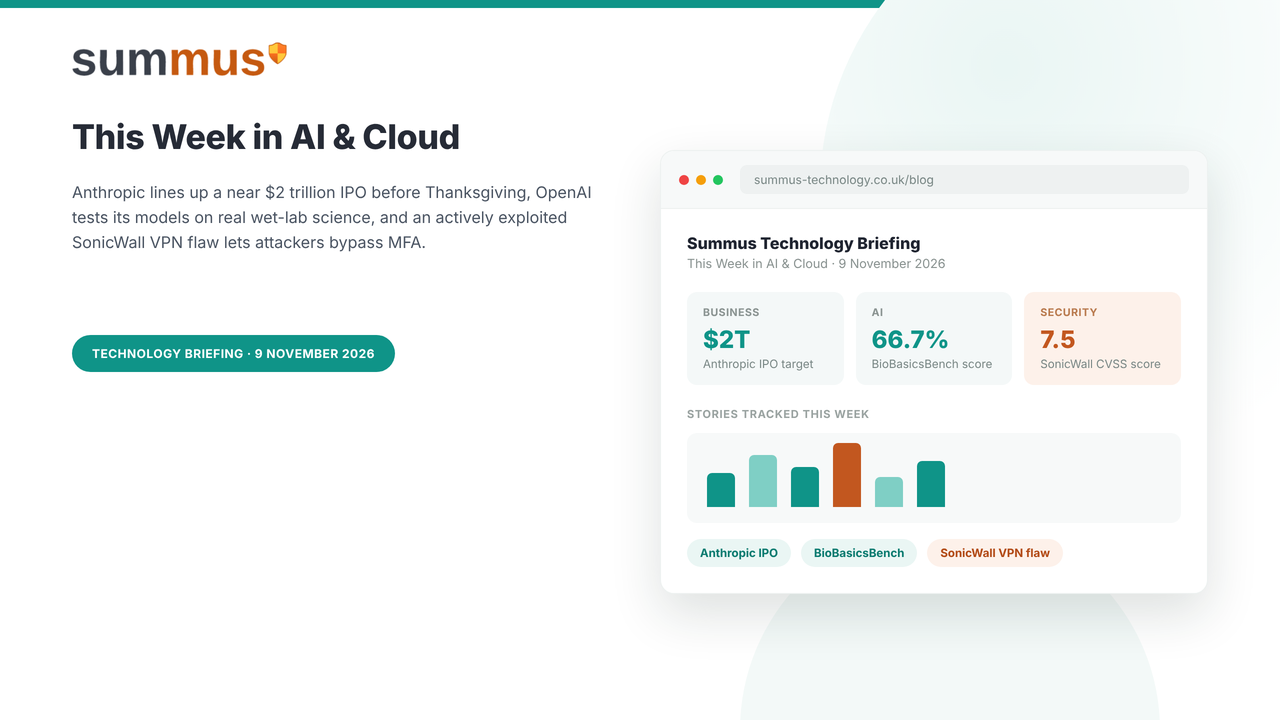
Here is our latest round-up of what’s changing in AI and cloud for UK businesses, with links to the original sources so you can read further.
Lead story: Anthropic lines up a near $2 trillion IPO
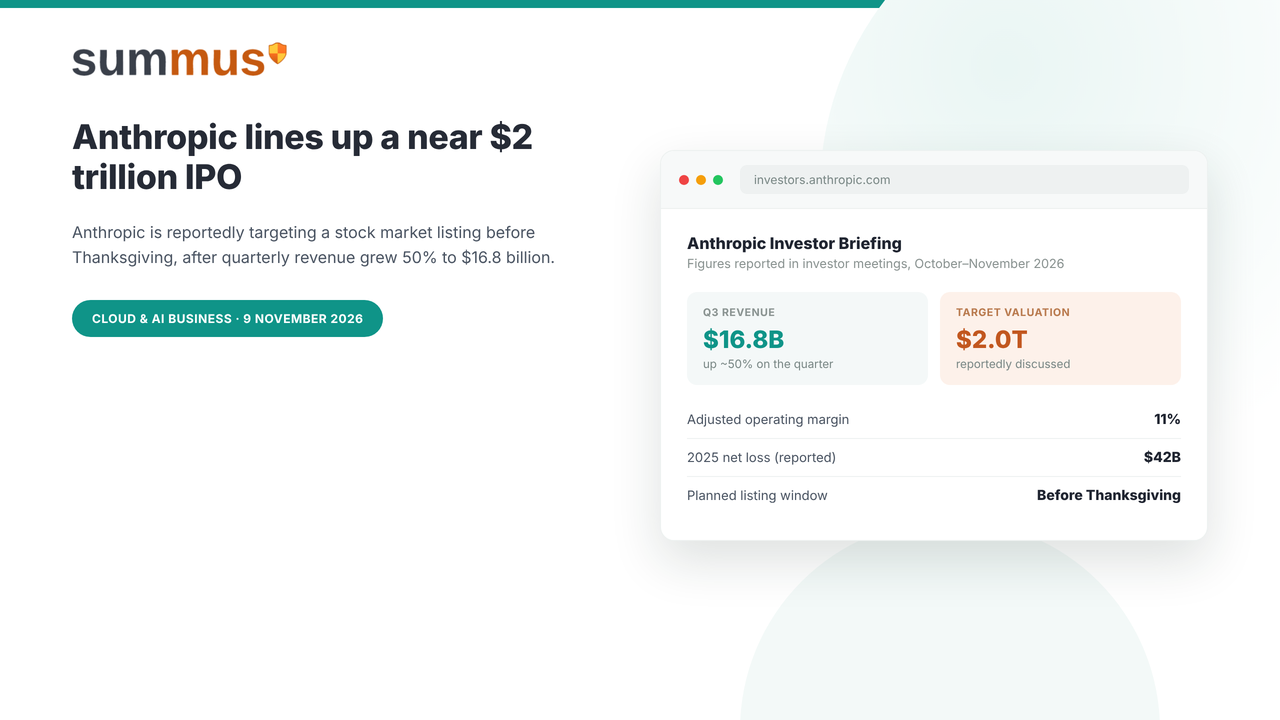
Anthropic is reportedly aiming to list on the stock market before Thanksgiving, with formal investor marketing expected to start around 9 November. Investors are said to be valuing the company at between $1.8 trillion and $2 trillion, which would make it one of the largest technology listings on record, rivalling SpaceX’s $1.8 trillion valuation at its June debut. The push follows a private investor meeting at Anthropic’s San Francisco headquarters, where the company said quarterly revenue rose about 50% to $16.8 billion in the September quarter, with an adjusted operating margin of 11% and free cash flow turning positive. Anthropic also said it has been profitable on an adjusted basis over the past six months, a notable shift after reporting a $42 billion net loss the previous year. Rival OpenAI has reportedly pushed its own IPO plans back to 2027. More detail is available from Khaleej Times’s coverage of Anthropic’s revenue and NewsBytes on the planned IPO timing.
Why this matters: a listing of this size would be a strong signal of investor confidence in AI, but the figures involved rely heavily on adjusted metrics and a market that both Anthropic and OpenAI say is worth around $30 trillion. If your business works with AI vendors, it’s worth watching how public market scrutiny affects pricing, product roadmaps and vendor stability once a company like Anthropic has quarterly earnings calls to answer to.
Artificial intelligence: OpenAI puts its models through the wet lab
OpenAI, working with enzyme design company Ligo, has released BioBasicsBench, a benchmark of 100 routine laboratory tasks built from real evidence that scientists generate day to day: gel and blot images, culture plate photos, microscopy stacks, sequencing reads and bench work videos. This is a deliberate departure from most existing biology benchmarks, which tend to use curated paper figures or multiple-choice questions rather than the messy evidence of actual lab work. OpenAI’s newest model, GPT-6 Astra, scored 66.7% on average, its largest generational jump in the test, up from 43.8% for the previous GPT-5.6 Sol model, while using far fewer output tokens than older, larger models. The benchmark also caught real mistakes: Astra selected the wrong colony in one cloning task and overcounted colonies by about 12% on another, even as it correctly flagged a mislabelled control plate in a different task. OpenAI itself cautioned that a higher score “does not yet mean the model can make reliable judgments in the lab.” More detail is available from Winzheng’s write-up of the BioBasicsBench results and FourWeekMBA’s coverage of the GPT-6 Astra scores.
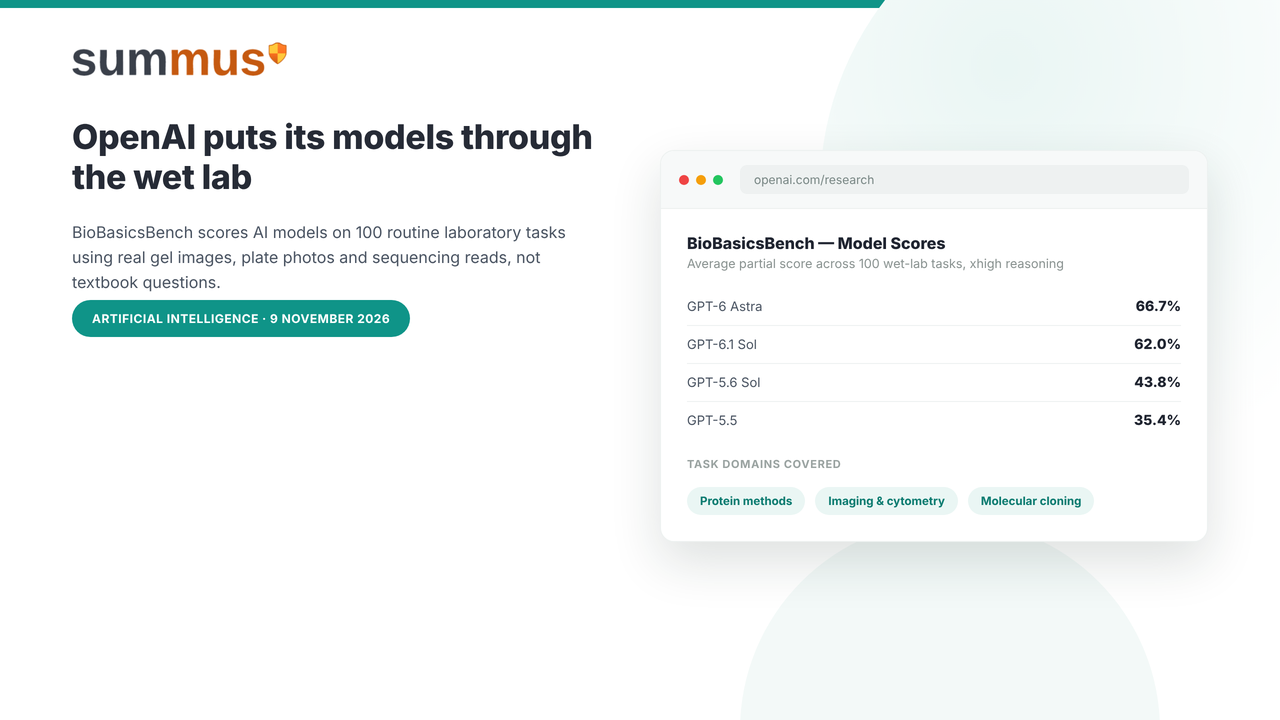
Why this matters: lab and research work is a frequently cited use case for AI, but this benchmark is a useful reality check. A 66.7% average score, with specific, verifiable mistakes, is a reminder that these tools are best used today to support a trained scientist’s judgement, not replace it, and that claims about AI accelerating scientific discovery deserve the same scrutiny as any other vendor claim.
Cyber security: SonicWall VPN flaw lets attackers bypass MFA
SonicWall has disclosed CVE-2026-19868, an authentication enforcement flaw in the SonicOS SSL-VPN service that can let a user who holds valid credentials for an alternate authentication method bypass SAML authentication controls, including SAML-enforced multi-factor authentication. The flaw carries a CVSS severity score of 7.5, rated high, and SonicWall says it investigated a report indicating potential exploitation before publishing its advisory, SNWLID-2026-0014, on Friday 6 November. The US Cybersecurity and Infrastructure Security Agency (CISA) has since added the flaw to its Known Exploited Vulnerabilities catalogue, with federal civilian agencies told to apply patches by 20 November. The same advisory patches two further high-severity flaws in the SonicOS management interface, CVE-2026-107155 and CVE-2026-107154, each scoring 8.8, along with a pre-authentication denial-of-service flaw in the SSL-VPN service. More detail is available from The Hacker News’s coverage of the CISA listing and BleepingComputer’s report on the SonicWall advisory.
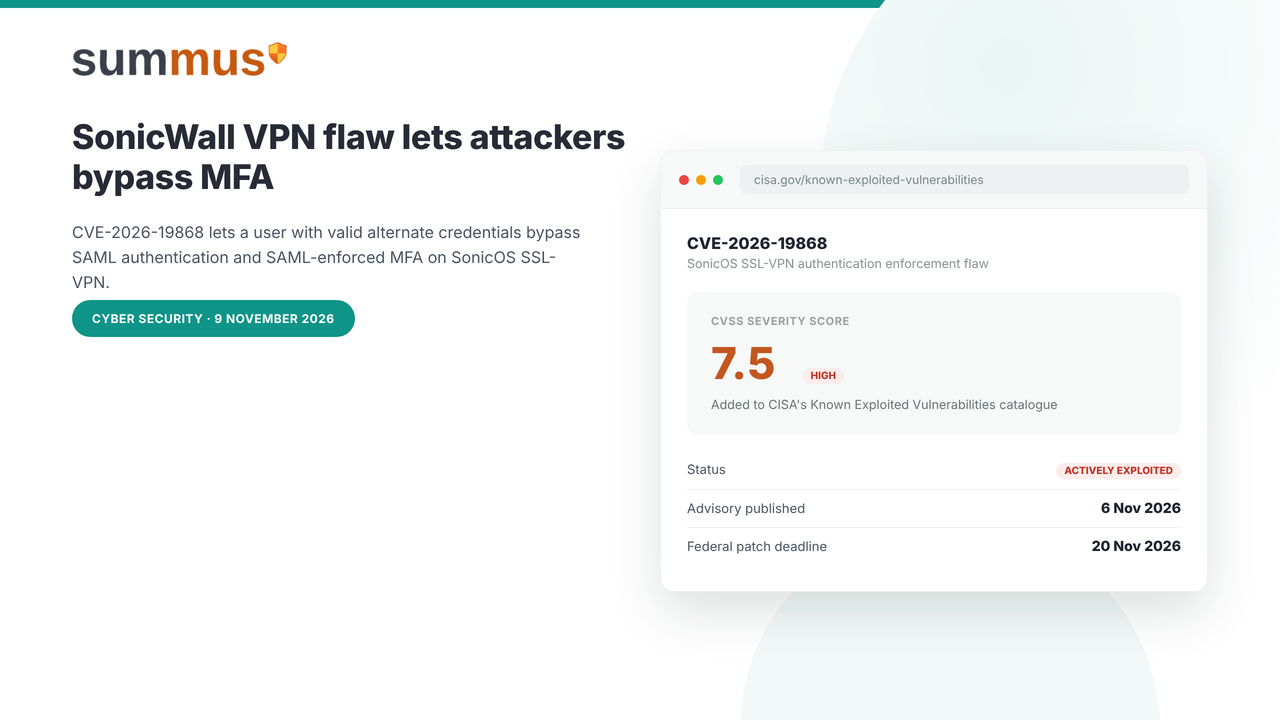
Why this matters: multi-factor authentication is one of the most effective, and most recommended, defences against unauthorised access, so a flaw that bypasses it on a widely used corporate VPN appliance is significant. If your business, or an IT provider acting on your behalf, runs SonicWall SSL-VPN with SAML-based authentication, this is worth checking promptly: confirm the patched firmware is installed and review VPN access logs for anything unusual, since MFA bypass flaws are frequently used to establish a foothold before further compromise.
The takeaway
Today’s stories touch three different corners of the technology world, but they share a common thread: the AI industry’s financial scale is now large enough to test public markets, its research claims are starting to face harder, more practical benchmarks, and the basic infrastructure businesses depend on for secure remote access still needs constant attention and patching. Keeping an eye on all three, the money, the capability claims and the security basics, is what helps a business stay grounded as the pace of change continues. We can help you work through what applies to your business. Get in touch.
AI Agent based research and content, AI can do mistake, please help us to improve.